
A2 Science
A2 Bilona Ghee: What It Is, Why It Costs More, and How to Spot the Real One
On this page
- A2 Bilona Ghee is not just a cooking fat, but a traditional
- Understanding traditional ghee requires looking back at how
- The term A2 refers specifically to the protein structure fou
- Biological differences between A1 and A2 beta-casein protein
- True bilona ghee always begins with set curd rather than ind
- Churning cultured curd with a bi-directional wooden bilona c
- Slow cooking fresh butter over a low wood fire gives the ghe
- Granular texture in traditional ghee depends entirely on coo
A2 Bilona Ghee is not just a cooking fat, but a traditional kitchen staple deeply rooted in Indian heritage. Long before stainless steel factories and plastic pouches took over our grocery store shelves, our dadi-nanis judged a good meal by the aroma rising from the hot kadhai. That golden spoonful drizzled over hot khichdi or soft rotis was not just about extra taste; it brought warmth and comfort to the entire house. Today, as more families ask what goes into their food, this old way of making ghee is returning to urban kitchens. It is a slow, quiet process that takes patience and fresh milk from indigenous cows. When you taste a spoonful of genuine bilona ghee, you immediately notice the granular, daanedaar texture and nutty smell that industrial butter oil simply cannot duplicate.
Understanding traditional ghee requires looking back at how Indian households preserved butter for centuries. In desert regions like Rajasthan, keeping fresh dairy from spoiling in the summer heat was always a challenge for rural families. Dadi-nanis solved this by turning fresh morning milk into curd, churning it by hand, and gently simmering the butter over a low fire. This simple technique removed all water content and milk solids, leaving behind a stable golden fat that could last for months without any refrigeration. This was not a commercial industry back then; it was an everyday home ritual linked closely to cow care and seasonal routines. The method was not complicated, but it required time, clean wooden equipment, and an understanding of how fat behaves under gentle heat.
The term A2 refers specifically to the protein structure found in the milk of native Indian cow breeds. Milk contains two primary types of beta-casein proteins, known as A1 and A2, depending on the genetic makeup of the cow. Indigenous Indian cows like the Rathi, Tharparkar, Gir, and Sahiwal naturally produce milk containing only the A2 beta-casein protein. European crossbred cows like Holsteins and Friesians usually yield A1 protein milk due to genetic mutations that occurred centuries ago. While milk looks identical in a steel glass, our digestive system processes these two protein structures in entirely different ways. This fundamental biological difference explains why so many people who feel bloated after drinking regular commercial milk find native cow milk much easier on their stomach.
Biological differences between A1 and A2 beta-casein proteins affect how our gut digests dairy products. During digestion, the A1 protein breaks down into a peptide called BCM-7, which many research studies associate with stomach discomfort, heaviness, and mild inflammation. The A2 protein structure does not break down into BCM-7, allowing the body to digest it smoothly without triggering that heavy, uncomfortable feeling after meals. While clarified butter contains mostly pure fat, tiny traces of protein and milk solids remain in the finished jar. Having those microscopic traces come from an A2 source makes a noticeable difference for sensitive stomachs. This is why families looking for traditional nourishment specifically seek out ghee made from native, humped desi cows.
True bilona ghee always begins with set curd rather than industrial cream separated directly from raw milk. Modern dairies skip curdling entirely because high-speed mechanical separators can extract raw fat straight from warm milk in minutes. The traditional bilona process takes the longer route by boiling whole A2 milk, letting it cool, and adding a small spoon of dahi starter. Overnight, natural lactic acid bacteria ferment the milk into rich, firm curd. This fermentation step breaks down lactose and alters the fat structure, giving the finished ghee a subtle sour warmth and far better shelf stability. Skipping this curdling stage might save time for large factories, but it strips away the depth of flavor and digestive benefits that old-fashioned ghee was famous for.
Churning cultured curd with a bi-directional wooden bilona creates authentic makkhan with preserved cellular structure. In this second step, the set curd is placed in a large earthen or wooden vessel and churned continuously using a wooden churner called a bilona. The churner rotates clockwise and counter-clockwise, gently separating light, fluffy butter from the thin buttermilk, known locally as chhachh. Unlike high-speed steel blades that heat up fat and break down delicate fatty acid chains, wooden bilona churning works at room temperature. This gentle movement keeps the lipid structure intact while isolating clean, natural butter. The buttermilk left behind is drunk fresh with cumin and salt, ensuring that nothing from the morning milking goes to waste.
Slow cooking fresh butter over a low wood fire gives the ghee its characteristic daanedaar texture and rich aroma. Once the hand-churned makkhan is gathered, it goes into a thick brass or iron kadhai resting over a controlled flame. In traditional villages, dried cow dung cakes or fallen firewood provide a slow, even heat that cannot be matched by gas burners. As the butter melts, water evaporates slowly while the milk solids settle at the bottom, caramelizing into a deep golden shade. Knowing exactly when to remove the kadhai from the fire is an art passed down through generations. Take it off too early, and moisture remains; leave it a minute too long, and the ghee turns dark and bitter.
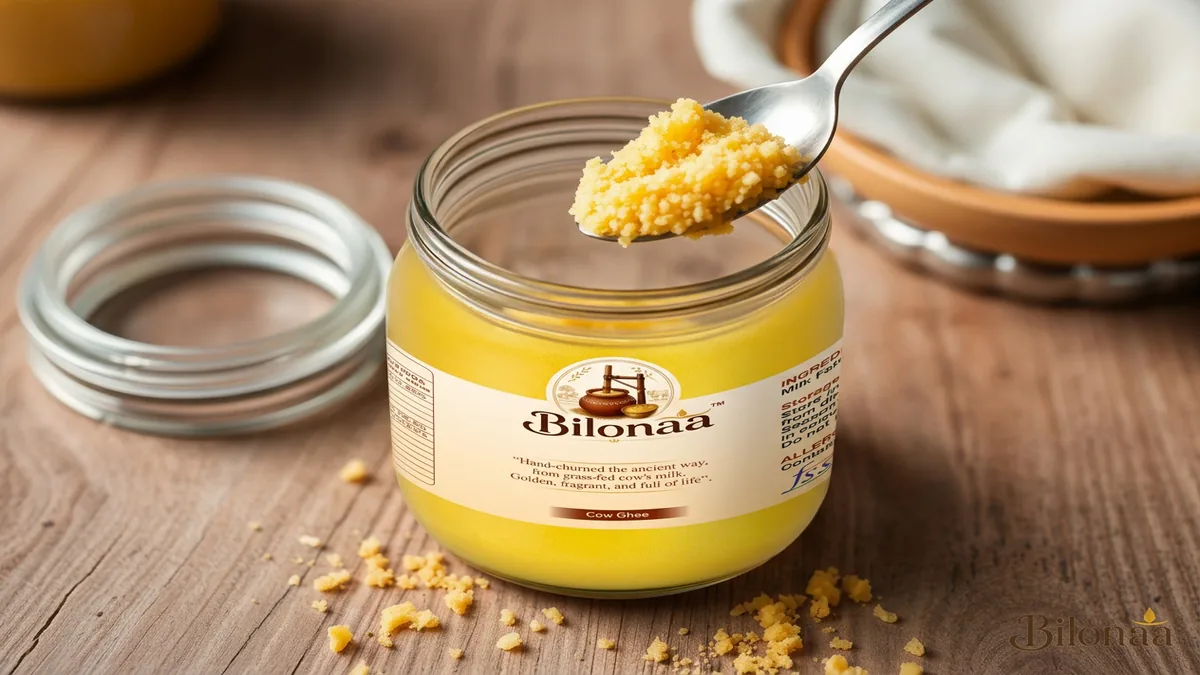
Granular texture in traditional ghee depends entirely on cooling rates and fat-crystal formation during preparation. That beautiful daanedaar texture everyone looks for in a glass jar is not added through artificial additives or temperature tricks. It happens naturally when the melted fat cools down slowly over several hours in a warm room. The different fatty acids in pure bilona ghee solidify at slightly different temperatures, creating microscopic lipid crystals that clump together into soft grains. Industrial ghee, produced by rapid chilling under steel coils, leaves behind a smooth, greasy paste without any grain structure. When you see coarse grains settled at the bottom of your jar on a cold winter morning, you are looking at pure, unadulterated fat cooling as nature intended.
Ayurveda considers authentic bilona ghee a sattvic food that nurtures digestive fire or agni when consumed daily. Classical Ayurvedic texts describe bilona ghee made from desi cow milk as a supreme rasayana, or rejuvenating tonic, that balances both Vata and Pitta doshas. It is traditionally believed to carry the herbal properties of spices deep into bodily tissues while lubricating the digestive tract. Unlike heavy vegetable oils that sludge up digestion, a small spoon of warm ghee before meals helps stimulate stomach juices without causing acidity. Ayurveda suggests that ghee prepared through the curd-churning method possesses cooling energy, making it suitable for daily use across all seasons, from hot desert summers to chilly northern winters.
Cooking with traditional ghee brings out deep flavor notes in spices during daily tadka and slow roasting. Beyond its traditional reputation, bilona ghee is a practical workhorse in any Indian kitchen due to its high smoke point around 250 degrees Celsius. You can heat it in a kadhai for frying pakodas or popping mustard seeds without worrying about smoke, burning, or harmful breakdown products. A quick tempering of cumin, garlic, and red chilies in warm ghee transforms a simple bowl of yellow dal into something memorable. Drizzling it over bajra rotis, stirring it into warm gajar ka halwa, or greasing a heavy pan for roasting parathas adds an unmistakable flavor that refined vegetable oils simply cannot match.
Industrial ghee manufacturing differs completely from handmade methods in speed, yield, and final nutritional content. Commercial dairies produce thousands of liters daily by separating cream from milk, boiling that raw cream at high temperatures, and adding synthetic flavor enhancers. This commercial method extracts almost double the yield from the same quantity of milk compared to the bilona method, bringing down production costs significantly. However, raw cream heating produces a heavy, greasy oil that lacks the complex aroma and digestible nature of fermented ghee. When you compare commercial cream-derived ghee against traditional bilona ghee, you are looking at two entirely different products made through two completely different philosophies of food preparation.
Families looking for gentle digestion and authentic flavor often benefit most from making the switch to traditional ghee. If someone in your house frequently experiences bloating, heavy stomach after meals, or mild lactose sensitivity, changing cooking oils can make a subtle difference. Children growing up need good dietary fats for nutrient absorption, especially vitamins A, D, E, and K which dissolve only in healthy fats. Elders who remember the rich taste of milk from fifty years ago often instantly recognize the clean, non-greasy feel of asli bilona ghee. Swapping chemically processed refined oils for traditional ghee in everyday cooking is one of the simplest dietary shifts an urban home can make toward whole foods.
Common myths about kitchen fats often ignore the difference between processed trans fats and clarified butter. For decades, traditional ghee was unfairly blamed for heart issues and weight gain as refined vegetable oils gained popularity across modern markets. Modern nutritionists now clarify that short-chain and medium-chain fatty acids found in natural ghee are processed quickly by the liver for steady energy rather than stored directly as body fat. The key, as our grandparents always maintained, lies in moderation and activity. Enjoying one or two teaspoons of pure A2 ghee daily alongside a balanced diet of whole grains and vegetables supports health rather than harming it, steering clear of artificial trans fats found in bakery shortenings.
Simple purity tests at home can help you identify adulteration like palm oil or starch in commercial ghee. Adulteration or milawat is a major concern when buying ghee off supermarket shelves today. A quick test involves heating a spoonful of ghee in a pan; genuine bilona ghee melts quickly and turns a deep brownish-golden color within seconds. If it takes long to melt and stays pale yellow, it likely contains vegetable fats. Another easy check is adding a drop of iodine to a small sample; if it turns blue, starch or potato paste has been added for weight. Pure ghee should also melt smoothly at body temperature when rubbed between your palms, leaving a nutty scent behind.
Pricing for genuine bilona ghee reflects the massive volume of raw milk needed to make a single jar. People often wonder why authentic bilona ghee costs upwards of fifteen hundred rupees a liter while factory ghee sells for half that price. The math is simple and transparent: it takes roughly 25 to 30 liters of pure A2 cow milk to extract just one liter of authentic bilona ghee. When you account for fair compensation to rural dairy farmers, feed for native cows, wood fuel, glass packaging, and labor-intensive hand churning, the cost makes complete sense. Shortcuts like using cheap raw cream or mixing vegetable oils lower the price, but they strip away the purity that makes traditional ghee valuable.
Storing your ghee in clean glass jars or traditional stainless steel dolchis keeps it fresh without refrigeration. Moisture and direct sunlight are the two main enemies of stored fat. Always use a clean, dry spoon to scoop ghee, as even a tiny drop of water can spoil the jar and cause mold growth over time. Keeping your ghee in food-grade glass jars or heavy stainless steel containers—like the traditional dolchis used by Bilonaa—in a cool pantry preserves its texture and natural aroma for up to a year. There is no need to keep ghee in the fridge; cold temperatures make it rock hard and disrupt its beautiful granular structure, making it difficult to spread on warm rotis.
Our family at Bilonaa prepares small batches in Bikaner using native Rathi and Tharparkar cow milk cooked over wood fires. In the arid heart of Rajasthan, our local Rathi and Tharparkar cows graze freely, yielding rich A2 milk filled with natural goodness. We stick strictly to the traditional two-way wooden bilona method, slowly simmering small batches of fresh makkhan in heavy vessels over wood fires. Every batch is poured carefully into glass jars or traditional stainless steel dolchis, keeping the process clean, honest, and fully FSSAI certified. At Bilonaa, we believe in bringing the quiet rhythm of Bikaner's winter mornings directly to your dining table, without additives, shortcuts, or modern compromises.
Choosing the right jar of ghee comes down to respecting age-old methods over modern shortcuts. In a world full of ultra-processed food labels and clever marketing, returning to simple, transparent ingredients is a quiet step toward better living. When you bring home genuine A2 bilona ghee, you are not just buying a cooking medium; you are supporting ethical cow care, rural artisans, and traditional Indian culinary wisdom. Take a moment to smell the jar when you open it, feel the coarse grains melt between your fingers, and enjoy that warm tadka in your evening meal. Real food does not need fancy claims—it simply speaks for itself through flavor, memory, and honest nourishment.
"It takes roughly 25 to 30 liters of pure A2 cow milk to extract just one single liter of authentic bilona ghee."
Bilonaa Promise
Small-batch, A2 desi-cow, traditional bilona ghee — straight to your kitchen.
100% pure, hand-churned, slow-cooked on a wood fire and packed in glass jars.
FAQs
Quick answers
What is the main difference between A2 Bilona Ghee and regular store ghee?
Regular store ghee is made commercially by boiling raw milk cream at high heat using steel machinery. A2 Bilona Ghee is made by culturing A2 milk from native Indian cows into curd, churning that curd with a bi-directional wooden bilona to separate butter, and slow-cooking the butter over a low fire.
Why is authentic A2 Bilona Ghee more expensive than standard ghee?
It takes approximately 25 to 30 liters of A2 cow milk to yield just one liter of authentic bilona ghee. The manual churn process, wood fire cooking, lower yield, and fair pricing for native cow care naturally make it pricier than industrial cream-derived ghee.
How can I check if my A2 Bilona Ghee is pure at home?
Melt a spoonful of ghee in a warm pan. Pure bilona ghee melts quickly and turns golden-brown almost immediately. You can also rub a drop on your palm; asli ghee melts at body temperature and leaves a distinct, nutty aroma behind.
Does A2 Bilona Ghee need to be refrigerated?
No, true bilona ghee should be stored at room temperature in an airtight glass jar or stainless steel dolchi. Keep it away from direct sunlight and water. Refrigeration hardens the fat and spoils its natural daanedaar grain structure.
Why does bilona ghee have a grainy or daanedaar texture?
The grainy texture comes from slow cooling at room temperature. Different fatty acids in natural cow butter crystallize at varying temperatures, forming soft, distinct grains naturally without industrial chilling or artificial additives.
Can people with mild lactose sensitivity consume A2 Bilona Ghee?
Many families find bilona ghee much easier to digest because curd fermentation breaks down lactose, and the slow-cooking process removes almost all milk solids. Furthermore, A2 beta-casein protein is naturally gentler on sensitive digestive systems.
Is A2 Bilona Ghee suitable for high-heat Indian cooking and tadka?
Yes, bilona ghee has a high smoke point of around 250 degrees Celsius. It does not burn easily or break down into toxic compounds, making it ideal for deep frying, roasting spices, or making daily tadka.
Educational content only — please consult a doctor for medical conditions.
Get gentle ghee notes in your inbox
One thoughtful Ayurveda + kitchen note a week. No spam. Unsubscribe anytime.
Conversation(0)
Share a thought — every comment is read before it appears.