
A2 Science
9 A2 Ghee Myths Indian Buyers Still Believe
On this page
- Understanding the confusion around modern pure ghee starts w
- Myth one claims that any jar carrying an A2 label was made u
- Myth two assumes that a darker brown or deep yellow color is
- Myth three treats a grainy daanedaar texture as a sign of ad
- Myth four warns that eating pure ghee every day will ruin yo
- Myth five restricts rich desi ghee consumption strictly to t
- Myth six insists that pure homemade or artisanal ghee must b
- Myth seven presumes that foreign organic certifications make
Understanding the confusion around modern pure ghee starts with untangling marketing labels from traditional kitchen wisdom. Walk into any grocery store across India today, and you will see dozens of shiny glass jars stamped with bold words like A2, organic, grass-fed, and hand-churned. While our dadi-nani knew authentic ghee simply by its comforting aroma over a hot kadhai, modern consumers are often left confused by conflicting claims. Misinformation spreads fast, leading many buyers to pay premium prices for industrial butter oil or reject genuine batch-made product because of natural variations in color and texture. To make sensible choices for your family meal times, it helps to examine what science, traditional kitchen experience, and traditional dairy practices actually tell us about [A2 cow ghee](/a2-cow-ghee). Let us separate real quality markers from widespread myths so you can shop with complete clarity.
Myth one claims that any jar carrying an A2 label was made using the traditional bilona process. The truth is that the term A2 refers strictly to the type of beta-casein protein present in cow milk, not how that milk was turned into ghee. Commercial brands often take A2 milk from hybrid or industrial setups, separate the cream using high-speed centrifuge machines, and directly boil that raw cream into ghee. Genuine artisanal ghee requires culturing whole milk into curd first, then slow-churning that curd with a bi-directional wooden churner via the [traditional bilona method](/traditional-bilona-method). Cream-derived ghee lacks the deep gut-friendly fermentation notes and complex fatty acid profile created during curd-based churning. An A2 label alone does not mean you are getting authentic cultured bilona ghee.
Myth two assumes that a darker brown or deep yellow color is proof of superior purity. In reality, the natural color of pure desi ghee depends on cow breed, seasonal fodder, and the exact cooking temperature during wood-fire clarification. Cows grazing on fresh green grass during monsoon months produce milk rich in natural beta-carotene, giving the ghee a pleasant golden yellow hue. Desert breeds feeding on dry scrub in summer yield a lighter, paler yellow shade. Furthermore, over-heating butter solids creates a darker brown tint and burnt aroma, which some low-grade makers use to hide imperfections. Never judge purity by darkness alone, as color naturally shifts from batch to batch throughout the farming calendar.
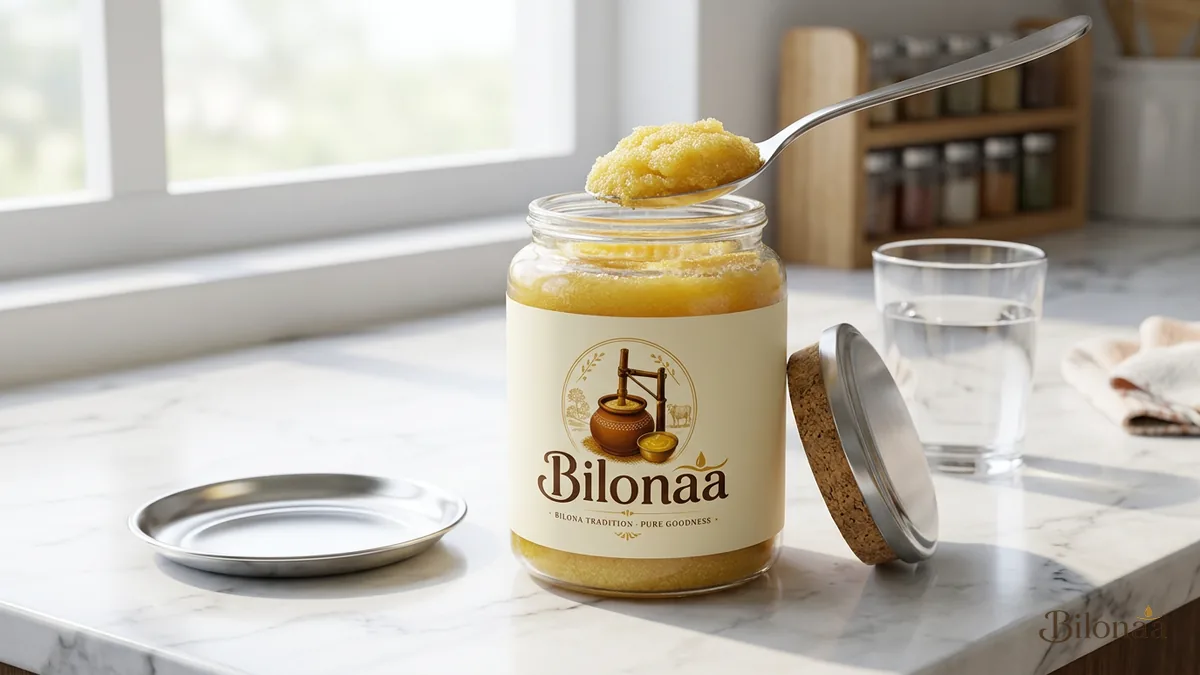
Myth three treats a grainy daanedaar texture as a sign of adulteration or product spoilage. Many buyers panic when they open a jar and find soft liquid resting over coarse grains, suspecting milawat with palm oil or vanaspati. However, a naturally daanedaar structure is actually a sign of authentic slow-cooled fat where palmitic and stearic fatty acids crystallize gradually at room temperature. Industrial ghee is rapidly chilled in refrigerated steel tanks, resulting in a smooth, uniform, petroleum-jelly-like paste. If your kitchen temperature changes between morning and night, natural ghee will melt and re-solidify into uneven granular layers. Natural graining proves the absence of chemical emulsifiers or artificial homogenizers.
Myth four warns that eating pure ghee every day will ruin your heart health and cholesterol profile. While over-consuming any fat is unwise, traditional wisdom and modern nutritional studies suggest that moderate intake of authentic desi ghee does not act like synthetic trans-fats. Pure ghee contains short and medium-chain fatty acids like butyric acid, which digest quickly and provide clean fuel for the liver rather than lingering in blood vessels. It also contains conjugated linoleic acid (CLA) and fat-soluble vitamins like A, D, E, and K. Eating a spoon of genuine ghee on warm dal or rotis daily helps lower glycemic response and supports gut lining integrity, provided your overall lifestyle remains active and balanced.
Myth five restricts rich desi ghee consumption strictly to the winter months of northern India. Many households relegate their ghee containers to the back of the pantry as soon as summer temperatures rise, fearing excessive body heat or indigestion. Ayurveda suggests that ghee possesses a cooling energy (sheeta virya) that actually helps soothe aggravated Pitta dosha during hot weather. Adding a small spoonful of ghee to morning breakfast or summer tadka protects the stomach lining from harsh spices and keeps digestive fire steady. Unless your physician has advised specific restriction, genuine ghee is a year-round dietary staple that supports tissue hydration even during dry, dusty Indian summers.
Myth six insists that pure homemade or artisanal ghee must be kept inside the refrigerator. Pure ghee has virtually zero moisture content when properly clarified, making it naturally shelf-stable for many months at room temperature. Refrigerating pure ghee actually introduces condensed water droplets inside the jar whenever you open it in a warm kitchen, encouraging mold growth along the inner rim. As long as you keep your jar in a cool, dry pantry away from direct sunlight and always use a clean, dry spoon, genuine ghee requires no cold storage. Traditional Indian kitchens kept ghee in brass or ceramic pots for seasons without spoiling, relying on simple hygiene instead of cold appliances.
Myth seven presumes that foreign organic certifications make imported butter oil better than native Indian breeds. Overseas organic butter oil often comes from Holstein or Angus cows raised on large commercial ranches, yielding A1 protein milk despite organic feed claims. Native Indian zebu cows like Rathi, Tharparkar, Gir, and Sahiwal possess the humped physiology specifically linked to natural A2 protein secretion. These indigenous breeds thrive in local climatic conditions, eating diverse wild flora that imparts unique medicinal aromas into their milk. Buying locally crafted ghee from native breeds supports indigenous dairy heritage while giving your family true A2 milk fat that no imported jar can match.
Myth eight assumes that paying two thousand rupees per liter automatically guarantees an unadulterated product. Price is often used by modern marketing brands to create an illusion of luxury, but high cost alone does not guarantee clean sourcing or correct process. Some expensive brands sell industrial cream-based A2 ghee wrapped in fancy imported glass packaging with heavy advertising budgets. Conversely, genuine small-batch makers incur real costs because making one liter of authentic bilona ghee requires roughly 25 to 30 liters of pure A2 milk. Rather than relying on price tag alone, buyers should evaluate lab reports, transparent sourcing, batch testing, and FSSAI licensing details before purchasing.
Myth nine advertises A2 desi ghee as a miracle cure for serious chronic diseases. In recent years, aggressive online marketing has painted A2 ghee as a magic remedy for everything from diabetes to joint degeneration and autoimmune conditions. While Ayurveda suggests that pure ghee acts as a fine carrier (anupana) for herbs and supports general vitality, it remains a food product rather than a medical cure. Treating ghee as a substitute for professional medical treatment is both unsafe and incorrect. Enjoying pure ghee daily aids digestion and nutrient absorption, but it works as part of a balanced diet rather than a standalone cure for illness.
Simple home testing methods can help you check ghee purity right in your own kitchen without lab equipment. To perform a basic palm test, place half a teaspoon of room-temperature ghee on your clean palm; authentic ghee melts quickly near body temperature (32 to 36 degrees Celsius), whereas lard or hydrogenated fats remain stiff. For the heat test, warm a spoonful in a small pan; pure ghee melts instantly and turns clear reddish-brown, while adulterated samples take longer and turn pale yellow. You can also test for starch or vanaspati by adding a drop of iodine solution to melted ghee—if it turns blue, milawat is present. These quick kitchen steps provide immediate reassurance before serving your family.
Verifying authentic A2 bilona ghee requires checking the sourcing practices and milk processing methods behind the brand. True artisanal production begins with free-grazing indigenous cows, follows natural curd fermentation overnight, and relies on hand-churning with wooden bilonas. When buying [bilona ghee](/bilona-ghee), check if the maker discloses the cow breeds used and provides accessible batch testing certificates for A2 protein purity. Responsible small producers cook the butter slowly over low flame, carefully skimming milk solids to preserve natural aroma and shelf stability. Taking a few minutes to read labels and verify manufacturer credentials protects your household from commercial shortcuts disguised as heritage recipes.
Proper storage techniques in traditional glass or stainless steel containers keep your ghee fragrant for months. Once you open a fresh container of pure ghee, transfer small amounts into a daily-use container to keep the main supply sealed. Always store your main ghee jar in a dark cupboard away from stove heat, steam, and direct sunlight. Water is the primary enemy of ghee; a single drop of water from a wet spoon can cause spoilage and sour odor over time. Clean glass jars with tight lids or food-grade stainless steel containers preserve the delicate caramel aroma of wood-fired ghee without leeching synthetic chemicals into your food.
Kitchen application across different Indian dishes shows how genuine bilona ghee behaves during everyday cooking. High smoke point (around 250 degrees Celsius) makes authentic ghee ideal for hot tadka, deep frying, and high-heat stir-frying in an iron kadhai without burning or breaking down into free radicals. When brushed hot onto phulkas or stirred into hot khichdi, genuine ghee releases a mild nuttiness that enhances dish flavors without leaving a greasy coating on your palate. Its natural emulsification properties also make it ideal for traditional sweet-making like halwa and besan laddu, where granular fat structure holds flour together perfectly.
Bilonaa brings authentic Bikaner craftsmanship straight from desert pastures to your home kitchen in small batches. Handcrafted in Rajasthan using milk from naturally grazing Rathi, Tharparkar, Gir, and Sahiwal cows, Bilonaa follows the traditional two-way wooden bilona method and slow wood-fire cooking. Every batch is prepared under strict quality standards (FSSAI 22226025000262) and packed into recyclable glass jars (500 ml, 1 ltr, 2 ltr) or traditional 5 ltr steel dolchis for larger households. If you want to experience asli daanedaar texture and honest desert aroma without commercial additives, you can easily [shop Bilonaa ghee](/shop) online or read [our story](/about) to see how our heritage process preserves real purity.
Learning to look past clever marketing hype empowers your family to choose truly nutritious, unadulterated food. Debunking these nine common ghee myths allows you to shop with confidence, judging quality by traditional sensory markers and transparent sourcing rather than deceptive labels. Real ghee is neither a scary health hazard nor a magical medicine; it is an ancient, nutrient-dense food crafted through careful biological transformation. By supporting authentic small-batch producers who honor traditional bilona methods, you bring wholesome flavor and genuine nutrition back to your dining table. If you still have questions about shelf life or usage, browse our helpful [FAQs](/faq) for detailed guidance on pure ghee care.
"Real ghee is neither a health hazard nor a magic cure; it is an ancient, nutrient-dense food crafted through careful biological transformation."
Bilonaa Promise
Small-batch, A2 desi-cow, traditional bilona ghee — straight to your kitchen.
100% pure, hand-churned, slow-cooked on a wood fire and packed in glass jars.
FAQs
Quick answers
How can I tell if A2 ghee is actually made using the bilona method?
Look at the label for cultured curd churning rather than direct cream processing. Bilona ghee has a distinct fermented, nutty aroma, an uneven daanedaar grain, and a slightly higher price point due to needing 25-30 liters of milk per liter of ghee.
Why does my A2 ghee look yellow in summer but paler in winter?
Seasonal fodder changes alter natural beta-carotene levels in cow milk. Monsoon green grass produces richer yellow butter, while dry winter scrub leads to paler shades. Variations are completely normal in natural ghee.
Is daanedaar ghee better than smooth cream-based ghee?
Yes, natural daanedaar graining occurs when ghee cools slowly at ambient temperatures, allowing fat crystals to form naturally. Smooth, uniform ghee is often factory-chilled rapidly or blended with emulsifiers.
Can people with lactose sensitivity digest pure A2 bilona ghee?
Many people with mild lactose intolerance find pure bilona ghee easy to digest because slow clarification removes almost all milk solids, lactose, and whey casein, leaving pure healthy fats.
Why shouldn't pure desi ghee be kept in the fridge?
Refrigeration introduces condensation when the jar is taken out into ambient humidity. Trapped moisture ruins ghee's natural self-preserving qualities and leads to sour odors. Store it in a dry pantry instead.
Does high heating destroy the nutrition in A2 cow ghee?
Pure ghee has a very high smoke point of approximately 250°C (482°F). Slow wood-fire clarification stabilizes its fatty acid bonds, allowing it to withstand normal Indian cooking and tadka without breaking down.
How long can an unopened jar of Bilonaa ghee stay fresh?
Stored in a cool, dark pantry away from direct sunlight, an unopened glass jar of Bilonaa ghee stays fresh and fragrant for up to 12 months from the date of packing.
Educational content only — please consult a doctor for medical conditions.
Get gentle ghee notes in your inbox
One thoughtful Ayurveda + kitchen note a week. No spam. Unsubscribe anytime.
Conversation(0)
Share a thought — every comment is read before it appears.