Customer FAQs
Baking with Ghee: How to Substitute It in Cakes and Cookies
On this page
- Can You Replace Butter with Ghee in Baking?
- How Much Ghee Should You Use Instead of Butter?
- A practical starting ratio
- Cookies need a separate judgement
- Weigh rather than estimate
- How to Substitute Ghee in Cakes
- When the recipe uses melted butter
- When the recipe creams butter and sugar
- For eggless cakes
- How to Substitute Ghee in Cookies
- Match the fat temperature to the method
- Bake one test cookie first
- Let the cookies set
- Can Ghee Replace Oil in a Cake?
- Troubleshooting Common Ghee Baking Problems
- The cake feels greasy or heavy
- The cake feels dry
- The batter looks lumpy
- The edges brown before the centre cooks
- Choosing Ghee for Your First Baking Trial
- Conclusion
The cake batter is halfway ready when you realise there is no butter in the fridge. There is, however, a jar of desi ghee beside the stove. Can you use it? Usually, yes—but the best substitution depends on whether your recipe calls for melted butter, softened butter or oil.
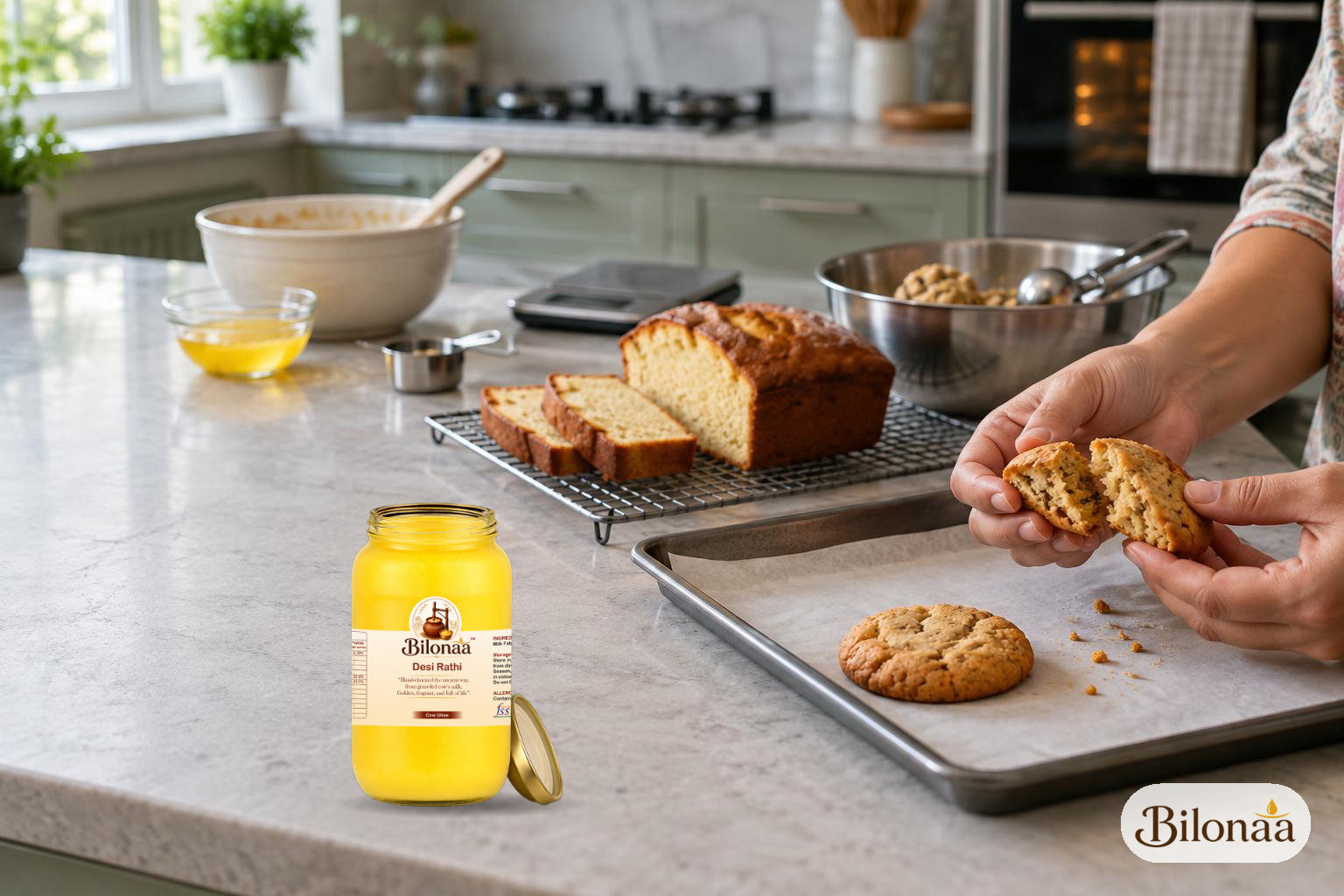
Baking with ghee can bring a lovely nutty aroma to tea cakes, biscuits and cookies. The trick is to account for the moisture that butter normally contributes and to use ghee at the right temperature. Here is a practical guide for Indian home kitchens, including warm-weather adjustments and tips for eggless recipes.
Can You Replace Butter with Ghee in Baking?
Ghee can replace butter in many everyday bakes, especially recipes using melted butter. However, it is not an identical ingredient. Butter contains fat, water and milk solids; ghee has most of its water and milk solids removed during preparation. A straight swap therefore changes more than the flavour.
That difference matters because water helps hydrate flour and creates steam during baking. Softened butter also traps air when beaten with sugar. Ghee behaves differently during creaming, so a delicate sponge may not rise or feel quite the same after substitution.
Start with forgiving recipes: banana bread, a simple chocolate loaf, melted-butter brownies or nankhatai made specifically with ghee. Save elaborate layer cakes and recipes that depend heavily on butter creaming until you have tried a small batch.
How Much Ghee Should You Use Instead of Butter?
A practical starting ratio
For a recipe calling for 100 g butter, a useful starting point is about 80–85 g ghee, with roughly 15–20 g water or milk added separately to the wet ingredients when the recipe needs that moisture. This is an approximate kitchen conversion, not a guarantee of identical results.
For example, a simple cake calling for 100 g melted butter could be trialled with 85 g melted, cooled ghee and 15 g water added to its liquid ingredients. Keep the remaining ingredients unchanged for the first attempt, so you can judge the substitution clearly.
Water is the simpler way to replace missing moisture. Milk also contributes solids and can affect browning and flavour, so the two are not completely interchangeable. Neither recreates butter's original structure merely by being added alongside ghee.
Cookies need a separate judgement
For cookies, begin with a similar reduced quantity of ghee, but consider the intended texture before adding liquid. Water affects sugar dissolution, flour hydration and spread. A chewy drop cookie and a crumbly shortbread-style biscuit will not respond in the same way.
If the recipe depends on butter's moisture, add the replacement liquid with the wet ingredients. If you want a dry, sandy biscuit, a recipe developed for ghee is more dependable than converting a butter recipe. Do not automatically add milk just because the dough looks different.
Weigh rather than estimate
A kitchen scale makes substitution easier. A spoonful of firm, grainy ghee can contain air gaps, while melted ghee fills the spoon differently. Do not treat grams and millilitres as equivalent, and use proper measuring spoons rather than a household serving spoon for small liquid additions.
How to Substitute Ghee in Cakes
When the recipe uses melted butter
This is generally the easiest conversion. Melt the measured ghee gently, then let it cool until it is still liquid but no longer hot. Add it at the same stage as the melted butter. Mix any replacement water or milk into the recipe's wet ingredients.
Keep eggs, curd and milk close to room temperature where the recipe permits. Fridge-cold ingredients can make melted ghee firm into small lumps. Once flour is added, mix only as much as the recipe requires; extra beating will not correct an uneven fat mixture and can toughen the crumb.
When the recipe creams butter and sugar
Use ghee that is soft and opaque, not hot and liquid. In a warm Indian kitchen, it may need brief refrigeration to become spreadable. Stir and check it frequently rather than chilling it into a hard block.
Beat it with sugar as directed, but do not expect exactly the same volume or texture as creamed butter. Even if the mixture becomes lighter, its ability to hold air may differ. For an important birthday cake, use a tested ghee recipe rather than relying on a first-time conversion.
For eggless cakes
Ghee can work in eggless cakes made with curd, milk or other binders, but it replaces the fat—not the eggs or the leavening system. Keep the specified curd, baking powder and baking soda unchanged initially. Adding more baking soda will not reliably fix a dense cake and may spoil its taste.
A simple curd-based loaf is a reasonable experiment. Record the ghee quantity, any added liquid and the finished texture once fully cool. Warm cake can seem softer than it will be after resting.
How to Substitute Ghee in Cookies
Match the fat temperature to the method
If a cookie recipe starts with melted butter, use melted, cooled ghee. If it begins by creaming softened butter, use soft, semi-solid ghee. Pouring liquid ghee into a creaming-style recipe changes the mixing method as well as the ingredient.
Cookie spread depends on several factors, including fat temperature, sugar, flour and dough moisture. Ghee does not automatically make every cookie spread more or less. Judge the actual dough and baked result instead of assuming one fixed outcome.
Bake one test cookie first
Chill the dough if the recipe calls for it, or if it has become unusually soft while mixing. Then bake one cookie on a cool, lined tray. Let it cool enough to assess its shape and texture before baking the full batch.
If it spreads too far, try chilling the remaining dough further before changing the flour. If it remains a thick mound, the dough may be very cold or dry. A test cookie helps you avoid unnecessary additions that could make the entire batch hard.
Let the cookies set
Ghee-based biscuits can be fragile while hot, particularly those with a crumbly texture. Let them firm up on the tray before moving them to a rack. Judge crispness after cooling, not straight from the oven.
Cardamom, chopped almonds, pistachios and chocolate pair well with ghee's flavour. For your first trial, keep the original sugar and flour unchanged. Replacing maida with atta, sugar with jaggery and butter with ghee together makes troubleshooting much harder.
Can Ghee Replace Oil in a Cake?
For many simple oil-based cakes, melted ghee can be tried in the same quantity, using the recipe's original measuring method. If it specifies 80 g oil, begin with 80 g melted, cooled ghee. If it specifies oil by volume, measure the liquid ghee by volume too.
Unlike the butter substitution, there is normally no missing water to replace when swapping oil for ghee. The main changes are flavour and firmness: ghee sets as it cools, while many everyday baking oils remain liquid.
An oil cake may therefore feel firmer with ghee, particularly after refrigeration. Banana, carrot and chocolate loaves are sensible starting points. Avoid making your first experiment a delicate chiffon cake, where the balance of oil, liquid and whipped eggs is especially important.
Troubleshooting Common Ghee Baking Problems
The cake feels greasy or heavy
Check whether you replaced butter with an equal weight of ghee without adjusting for butter's other components. Poor mixing, insufficient aeration or underbaking can also cause a heavy result. Review the quantities and method before blaming the ghee alone.
The cake feels dry
Missing replacement moisture, excess flour or overbaking may be responsible. Weigh the flour and begin checking at the recipe's earliest suggested time. For a typical tea cake, look for a set centre and a skewer without wet batter, allowing for moist additions such as fruit or chocolate.
The batter looks lumpy
Cold ingredients may have caused the ghee to set. Prevent this by bringing ingredients to compatible temperatures before mixing. Do not aggressively heat an assembled batter or keep beating after adding flour in an attempt to remove every small lump.
The edges brown before the centre cooks
Keep the original oven temperature for your first trial; ghee's suitability for high-heat cooking is not a reason to raise it. Dark tins, rack position and oven hot spots can affect browning. Preheat fully and use the same tin size the recipe specifies.
Choosing Ghee for Your First Baking Trial
Choose ghee whose aroma you enjoy, because it will be noticeable in plain cakes and biscuits. Traditional bilona preparation involves churning curd to obtain makhan before making ghee. That production method does not require a special baking ratio; the recipe still depends on fat, moisture and mixing.
Bilonaa makes traditionally churned bilona A2 desi cow ghee in Bikaner, Rajasthan. If you already use it for roti or tadka, a small batch of cardamom cookies is a practical way to explore its flavour in baking. A2 describes the milk source, not a promise of better cake rise.
Conclusion
The most useful rule for baking with ghee is to identify what the original fat does. When replacing butter, consider both fat and missing moisture. When replacing oil, focus on temperature, flavour and how the bake will feel once cool.
Start with a familiar recipe, weigh carefully and change one thing at a time. If you would like to try a traditionally made option, explore Bilonaa's ghee range and begin with a small weekend bake.
Bilonaa Promise
Small-batch, A2 desi-cow, traditional bilona ghee — straight to your kitchen.
100% pure, hand-churned, slow-cooked on a wood fire and packed in glass jars.
FAQs
Quick answers
Can I replace butter with ghee in a 1:1 ratio?
Some recipes tolerate it, but it is not a dependable universal rule. For 100 g butter, about 80–85 g ghee plus appropriate replacement moisture is a more considered starting point. The recipe's mixing method and intended texture still matter.
Do I need to add milk when baking cookies with ghee?
Not always. Replacing butter's moisture can help some cookies, while added milk may change the texture of a crumbly biscuit. Follow a ghee-specific recipe where possible, or bake a test cookie before adjusting the dough.
Will ghee make my cake taste like an Indian sweet?
Ghee adds a distinctive aroma, especially in plain vanilla or cardamom cakes, but it will not necessarily dominate. Chocolate, coffee and spices can balance its flavour. Try a small batch to judge your household's preference.
Should I change the oven temperature when using ghee?
Usually, keep the recipe's original temperature and tin size for your first attempt. Check doneness rather than relying only on the timer. A higher smoke point does not mean cakes or cookies should be baked at a higher temperature.
Are cakes made with ghee dairy-free or suitable for milk allergy?
No. Ghee is derived from milk and should not be treated as dairy-free or assumed safe for milk allergy. The A2 description does not change that. Use an appropriate dairy-free baking fat when dairy must be avoided.
Educational content only — please consult a doctor for medical conditions.
Get gentle ghee notes in your inbox
One thoughtful Ayurveda + kitchen note a week. No spam. Unsubscribe anytime.
Conversation(0)
Share a thought — every comment is read before it appears.