
Bilonaa Method
Bilona Ghee: The Complete Indian Guide to the Real Thing
On this page
- Understanding what traditional bilona ghee really means in a
- The deep cultural history behind hand-churned ghee across ru
- Setting curd from whole milk is the crucial first step of th
- Churning curd bi-directionally with a wooden churner creates
- Slow cooking butter over a gentle wood fire develops the sig
- The science of fat structure explains why butter-churned ghe
- Ancient Ayurvedic texts regard bilona ghee as a key rasayana
- Cooking with hand-churned ghee adds warmth and depth to ever
Understanding what traditional bilona ghee really means in an Indian kitchen begins with memories of aroma and granular texture. If you grew up in a house where ghee was cooked on a low flame, you know that smell. It fills the courtyard, sticking to your sweater on a chilly winter morning, rich, warm, and deeply comforting. Most commercial jars sitting on supermarket shelves today are made by running fresh raw cream through high-speed industrial centrifuges. Real bilona ghee takes a completely different road. It starts by boiling full-fat milk, cooling it down, and setting it into thick curd overnight. That curd is then churned manually using a bi-directional wooden churner until fresh butter separates from buttermilk. That butter, slowly melted over small wood fires, is what creates true ghee. It is about respecting how fat, heat, and time interact.
The deep cultural history behind hand-churned ghee across rural India spans thousands of years of traditional kitchen wisdom. Long before modern dairy processing plants existed, Indian households managed surplus milk by turning it into curd and then butter. In towns across Rajasthan and Gujarat, every family had a heavy wooden churning rod supported by a wall rope. Dadi or nani would sit in the early morning breeze, pulling the rope in alternating directions, producing a steady rhythm as familiar as the kitchen bell. This bi-directional churning motion was called bilona. The process preserved milk fat without spoiling in hot weather, creating a stable fat that did not require refrigeration. Across generations, this method was cherished not just for preserving milk, but for creating a fat that cooked gently and nourished families through dry summers.
Setting curd from whole milk is the crucial first step of the genuine bilona process. You cannot shortcut this step by taking fresh cream skimmed directly off raw milk and putting it onto high heat. In true traditional making, fresh milk from desi cows is first boiled thoroughly in open vessels and allowed to cool to room temperature. A spoonful of natural starter culture, saved from yesterday curd batch, is mixed in carefully. Over eight to twelve hours, natural bacteria ferment the milk lactose into lactic acid, turning liquid milk into firm, aromatic dahi. This fermentation breaks down complex milk proteins and fats into simpler forms before heat ever touches the mixture. Skipping curd formation strips away the deeper, cultured flavor notes that make authentic ghee so distinct to the palate.
Churning curd bi-directionally with a wooden churner creates true fresh makhan without destroying delicate fat globules. Once the curd has fully set, it is poured into a large clay pot or heavy wooden vessel. A wooden churner, locally known as a Mathani or Ravaiya, is lowered into the center. Wrapped around the wooden axle is a thick rope pulled alternately with two hands, spinning the wooden blades clockwise and counter-clockwise. This alternating motion gently coaxes fat molecules to cluster together while separating the liquid chaas or buttermilk. High-speed metal blades in modern factories whip air into the fat and shear through lipid chains, whereas wooden bilona churning preserves the natural structure of milk fat. The resulting soft makhan is washed with clean water to remove excess milk solids.
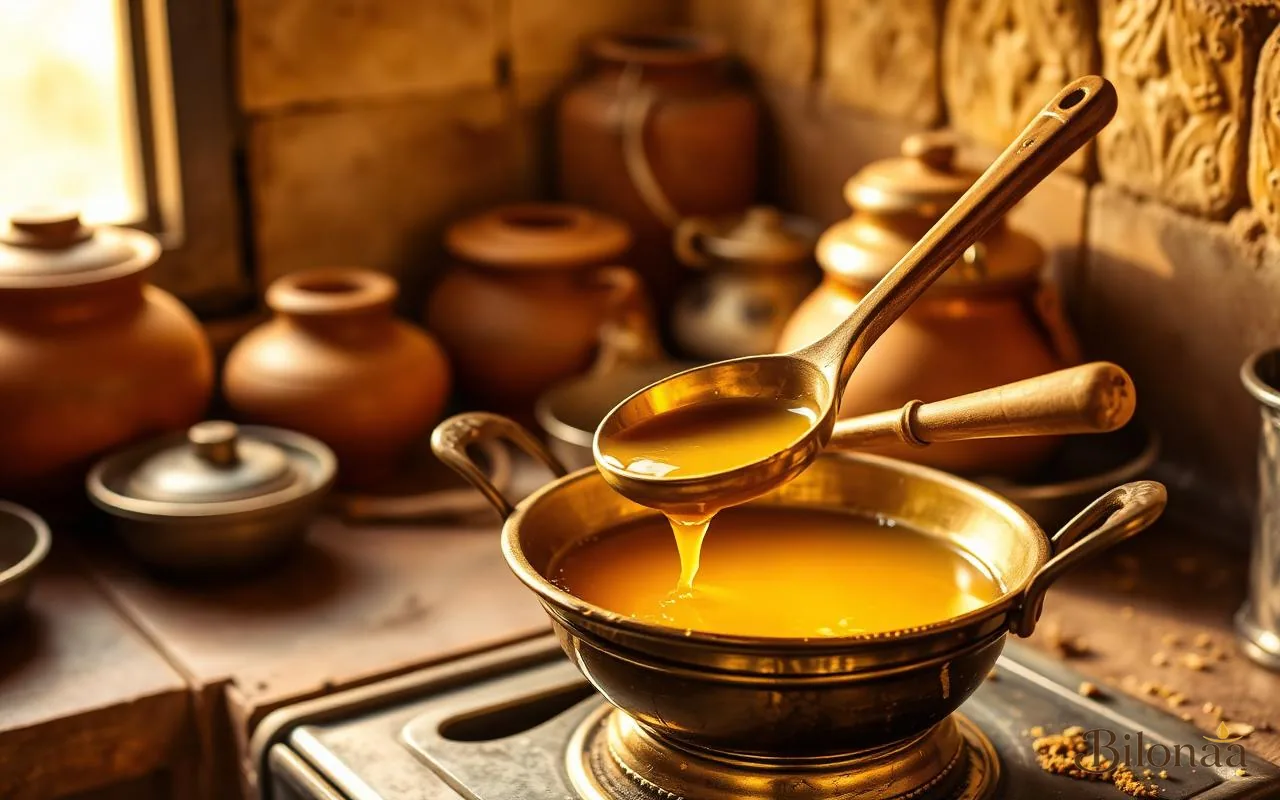
Slow cooking butter over a gentle wood fire develops the signature golden aroma and grainy texture. The washed butter is placed in a heavy brass or cast-iron kadhai and kept over steady, low heat. As the butter warms, liquid evaporates, and milk solids settle down toward the bottom of the pot. A gentle crackling sound echoes as residual moisture boils off, filling the air with a toasted, nutty perfume that signals the ghee is almost ready. Cooking it too quickly over high gas flames burns the solids and turns the ghee dark and bitter. Gentle heat from dried wood or low embers allows milk solids to caramelize lightly, giving the fat its golden amber hue and characteristic daanedaar texture that solidifies smoothly as it cools down in jars.
The science of fat structure explains why butter-churned ghee behaves differently during high-heat cooking. When milk goes through lactic fermentation before churning, short-chain and medium-chain fatty acids are released, making the fat easier for the human digestive system to process. Bilona ghee contains natural levels of butyric acid, a short-chain fatty acid known for supporting gut lining health and smooth digestion. Additionally, because the water and milk solids are thoroughly separated during slow cooking, pure ghee reaches a high smoke point around four hundred and eighty degrees Fahrenheit. This high thermal stability means it does not easily break down into harmful free radicals or toxic smoke when you fry spices, roast grains, or sear vegetables over high heat.
Ancient Ayurvedic texts regard bilona ghee as a key rasayana for daily nourishment and cellular vitality. In classical scriptures like Charaka Samhita, ghee made from fermented curd is classed as a premier vehicle or anupana for carrying herbal preparations deeper into body tissues. It is traditionally believed to balance both Vata and Pitta doshas while stoking the internal digestive fire, known as Agni, without causing inflammation or heaviness. Ayurveda suggests that ghee prepared by the bilona method nourishes bodily tissues from plasma to reproductive fluid. Old vaidyas often recommend a spoon of warm ghee stirred into milk or warm water during cold mornings to lubricate joints and calm the digestive tract, emphasizing that fresh cream ghee simply lacks these traditional energetic qualities.
Cooking with hand-churned ghee adds warmth and depth to every simple daily meal in an Indian home. You do not need lavish feast recipes to appreciate what good ghee does. A small spoon drizzled over steaming hot arhar dal, mixed into fresh khichdi, or rubbed over a hot phulka transforms humdrum food into something immensely satisfying. The natural nutty taste amplifies dry spices like cumin, mustard seeds, and asafoetida during a quick tadka without overwhelming the original flavors of the lentils or vegetables. Because of its daanedaar texture, it coats grain surfaces evenly instead of making them feel greasy. Even a basic bowl of boiled potatoes gains a golden glaze and rich aroma that refined oils can never replicate.
Industrial cream-derived ghee is fundamentally different from authentic bilona ghee in both process and final character. Modern commercial brands save time and expense by collecting raw cream directly from milk separators in large central plants. This cream is directly heated at high temperatures or treated with commercial starters to separate butter oil quickly. This shortcut bypasses natural curd fermentation entirely. As a result, factory ghee often feels slick, flat, or overly greasy on the tongue, lacking that authentic granular grain and deep cultured aroma. Furthermore, factory processing often relies on milk pooled from modern cross-bred cattle raised on industrial feed, whereas traditional bilona makers rely on indigenous Indian cow breeds raised on natural pasture and local fodder mixes.
A2 milk from indigenous cow breeds gives traditional ghee its distinct yellow color and easy digestibility. Native Indian cow breeds—such as Rathi, Tharparkar, Gir, and Sahiwal—produce milk containing the A2 beta-casein protein variant. Many families find that dairy products made from A2 milk are far gentler on sensitive stomachs compared to A1 protein milk from imported breeds like Holstein-Friesian. The natural diet of these indigenous cows, often grazing on green grass and seasonal desert flora, enriches their milk with natural beta-carotene, giving rendered ghee its soft golden color. When this rich A2 milk undergoes the slow curd-and-bilona process, the result is a clean, nutrient-dense cooking fat with an unforgettable traditional flavor profile.
Identifying who benefits most from switching to real handcrafted ghee in daily life comes down to simple dietary wellness. Busy urban households who want clean, nutrient-dense fats for daily cooking will appreciate how light real ghee feels in the stomach. Active individuals and fitness enthusiasts frequently turn to it as a source of sustained energy that does not trigger sharp blood sugar spikes. Parents trying to build healthy food habits for growing children find that adding a spoonful of pure ghee to rotis and warm khichdi improves nutrient absorption and keeps kids satisfied longer. Even older family members who struggle with dry skin or joint stiffness find comfort in traditional foods prepared with genuine, slow-crafted fat.
Debunking common myths about ghee fat content and cholesterol in home diets helps families make calmer kitchen choices. For years, refined oil advertisements convinced urban homes that all saturated fats were harmful to cardiovascular health. However, modern nutritional understanding recognizes that natural, unadulterated fats play essential roles in hormone balance, brain health, and fat-soluble vitamin absorption. Bilona ghee consists mostly of stable monounsaturated and saturated fatty acids that do not oxidize easily under normal cooking heat. When consumed in balanced amounts alongside whole grains, seasonal vegetables, and active daily movement, pure ghee is a traditional food staple rather than a dietary risk. Real food, prepared through traditional methods, works with the body.
Simple kitchen tests can help you verify the purity of your home ghee stash against common adulteration tricks. To check for added vegetable oils or starches, perform the warmth test: place a small teaspoon of ghee on your palm. Pure bilona ghee melts almost instantly at body temperature due to its clean melting point. Another test involves heating a spoonful in a small metal pan; genuine ghee melts quickly and turns dark brownish-golden within seconds, while adulterated ghee takes longer to melt and stays pale yellow. You can also add a drop of iodine to melted ghee in a glass bowl; if it turns blue, starch or potato paste has been mixed in to add bulk.
The real cost of making authentic bilona ghee reflects labor volume, time, and raw milk requirements. To yield just one single liter of pure bilona ghee, a craftsperson needs roughly twenty-five to thirty liters of whole A2 milk. When you factor in the daily care of indigenous cattle, natural feeding, manual curd setting, morning bilona churning, and slow wood-fire cooking, the production cost is naturally higher than mass-produced factory ghee. When a jar on a store shelf claims to be pure bilona ghee yet sells at half the price of fresh milk, simple math tells you something was compromised—either by blending raw cream, adding commercial butter, or stretching fat with palm oil. Quality fats require patience.
Proper storage methods preserve the distinct daanedaar texture for months without spoiling or turning rancid. Ghee is inherently stable because water and milk solids are completely removed during slow cooking, leaving pure fat behind. Store your ghee in a dry glass jar or traditional stainless steel container away from direct sunlight and damp steam near the stove. Always use a clean, dry wooden or metal spoon when scooping it out, as introducing even a small drop of moisture into the jar can encourage mold growth over time. Refrigeration is unnecessary and can actually ruin the natural granular grain structure, making the fat hard and waxy. Kept cleanly at room temperature, good ghee stays sweet and aromatic.
Our family at Bilonaa continues this quiet craft in the heart of Bikaner, Rajasthan, keeping old traditional ways alive. In our small facility, we work exclusively with milk from healthy native Rathi, Tharparkar, Gir, and Sahiwal cows that graze on local forage. Every batch is converted into dahi overnight, churned using sturdy wooden bilonas in the early morning, and slow-cooked over wood fires just like dadi used to do. We pack our ghee fresh into sturdy glass jars for smaller sizes up to two liters, and for larger five-liter orders, we ship in traditional stainless steel dolchis to keep it safe in transit. Under FSSAI registration number 22226025000262, we ensure every jar arriving at your kitchen table carries pure, unadulterated, daanedaar goodness.
Making the conscious choice to bring time-honored food traditions back to your table is a rewarding step toward better daily living. In a modern grocery market flooded with shortcuts, hyper-processed fats, and shiny commercial labels, choosing authentic bilona ghee is a quiet vote for honesty, taste, and kitchen heritage. It brings back the rich aroma of traditional Indian home cooking, where food was made with patience rather than mass mechanical scale. When you pour a warm spoon of asli ghee over fresh khichdi or warm rotis, you are not just seasoning your food; you are connecting with generations of kitchen wisdom that kept our families nourished, healthy, and satisfied.
"Real bilona ghee is not just about nostalgia; it is about respecting how fat, heat, and time interact in an Indian kitchen."
Bilonaa Promise
Small-batch, A2 desi-cow, traditional bilona ghee — straight to your kitchen.
100% pure, hand-churned, slow-cooked on a wood fire and packed in glass jars.
FAQs
Quick answers
What is the main difference between bilona ghee and normal commercial ghee?
Commercial ghee is made by directly heating raw cream skimmed from milk using high-speed industrial separators. Bilona ghee follows the ancient two-step process: whole milk is fermented into dahi, churned bi-directionally with a wooden bilona to separate makhan, and slow-cooked over a gentle fire. This yields a grainy texture and deeper cultured aroma.
Why does authentic A2 bilona ghee cost more than regular store ghee?
It takes about 25 to 30 liters of pure A2 milk to make just 1 liter of authentic bilona ghee. Combined with the labor of overnight curd fermentation, hand-churning with wooden rods, and low wood-fire rendering, the higher cost reflects the volume of milk and traditional craftsmanship involved.
Is bilona ghee safe for people with mild lactose sensitivity?
Yes, many people with lactose sensitivity digest bilona ghee easily. Converting milk into curd breaks down milk sugars (lactose), and the slow-cooking process removes milk solids (casein and whey) entirely, leaving pure, stable butter fat behind.
How can I easily test if my ghee is pure at home?
Try the palm test: place half a teaspoon of ghee on your palm; pure ghee melts quickly at body temperature. You can also heat a spoon of ghee in a metal pan—pure ghee melts fast and turns dark golden, while adulterated fat takes longer and stays pale yellow.
Should I keep my jar of bilona ghee in the fridge?
Refrigeration is not needed and can ruin the natural daanedaar granular texture, making the fat hard and waxy. Because true ghee contains zero water content, storing it at room temperature in a dry glass jar or stainless steel dolchi keeps it fresh for up to a year.
What cow breeds are used for Bilonaa ghee?
At Bilonaa, we source whole milk exclusively from native Indian cow breeds including Rathi, Tharparkar, Gir, and Sahiwal. These indigenous breeds are well-adapted to the desert climate of Bikaner and produce natural A2 milk rich in beta-carotene.
Educational content only — please consult a doctor for medical conditions.
Get gentle ghee notes in your inbox
One thoughtful Ayurveda + kitchen note a week. No spam. Unsubscribe anytime.
Conversation(0)
Share a thought — every comment is read before it appears.