Bilonaa Method
Bilona Method Ghee: The Eight Steps, Start to Jar
On this page
- The Bilona method is the ancient Indian process of turning c
- Historical references across Vedic texts show that ghee was
- The journey of authentic bilona ghee begins with pure A2 mil
- Slow boiling the raw milk over mild heat prepares it for cle
- Setting the warm milk into whole curd overnight is the essen
- Churning the cultured curd bi-directionally with a wooden ma
- Gathering the fresh makkhan leaves behind probiotic buttermi
- Clarifying the washed makkhan over a low wood fire transform
The Bilona method is the ancient Indian process of turning cultured curd into authentic desi ghee using a two-way wooden churner. Unlike modern dairy products made by boiling fresh milk cream, this traditional method relies on natural bacterial fermentation. In villages across Rajasthan, dadi-nani routines always began before sunrise with the soothing sound of the wooden mathani. The process transforms whole milk into dahi, churns that curd to separate raw butter, and slowly simmers the fat into golden liquid. The result is a light, fragrant oil filled with micro-nutrients that standard factory processing simply strips away.
Historical references across Vedic texts show that ghee was always processed from fermented curd rather than fresh milk cream. Ancient households understood that milk fat becomes far easier to digest once converted into dahi through lacto-fermentation. This culturing phase alters the protein structure, reducing lactose and casein down to negligible traces long before heat is introduced. Modern direct-cream extraction was invented much later to speed up industrial yields, but it bypassed the biological transformation that gave traditional ghee its place in classical Indian cooking and seasonal nutrition.
The journey of authentic bilona ghee begins with pure A2 milk drawn from indigenous Indian cow breeds like Rathi and Tharparkar. Free-roaming humped cows yield milk rich in the A2 beta-casein protein, which aligns better with human gut biology than imported hybrid cattle milk. On the dry pastures of Bikaner, native cows forage on local grasses, herbs, and shrubbery, giving their milk a distinct natural richness. Collecting unadulterated raw milk from well-cared indigenous cows forms the non-negotiable first step, as no amount of slow cooking can make up for poor starter milk.
Slow boiling the raw milk over mild heat prepares it for clean fermentation and destroys unwanted external bacteria. The fresh A2 milk is poured into thick iron or earthen vessels and heated gradually until it reaches a gentle boil. Boiling neutralizes stray microbes while allowing milk proteins to stabilize for the culturing phase. Once boiled, the milk cools down naturally to room temperature or slight warmness, which creates the ideal thermal environment for healthy curd starter to flourish without souring the batch.
Setting the warm milk into whole curd overnight is the essential foundation that separates bilona ghee from industrial butter oil. A spoonful of previous day's fresh dahi jamun is stirred into the cooled milk, which sits undisturbed in clay pots overnight. During these quiet hours, natural lactic acid bacteria multiply throughout the milk, consuming lactose and breaking down complex fats. By early morning, the liquid converts into firm, sweet dahi with a soft aromatic layer of cultured cream settled across its surface.
Churning the cultured curd bi-directionally with a wooden mathani releases raw butter while preserving sensitive nutrients. The firm curd is mixed with clean cool water and churned back and forth using a traditional wooden pole wrapped in rope. The bi-directional movement creates gentle fluid friction, causing fat globules to collide and stick together without tearing their delicate lipid membranes. This mechanical action separates the white cultured makkhan from the tangy liquid buttermilk underneath, keeping the fat cool and unheated throughout the transformation.
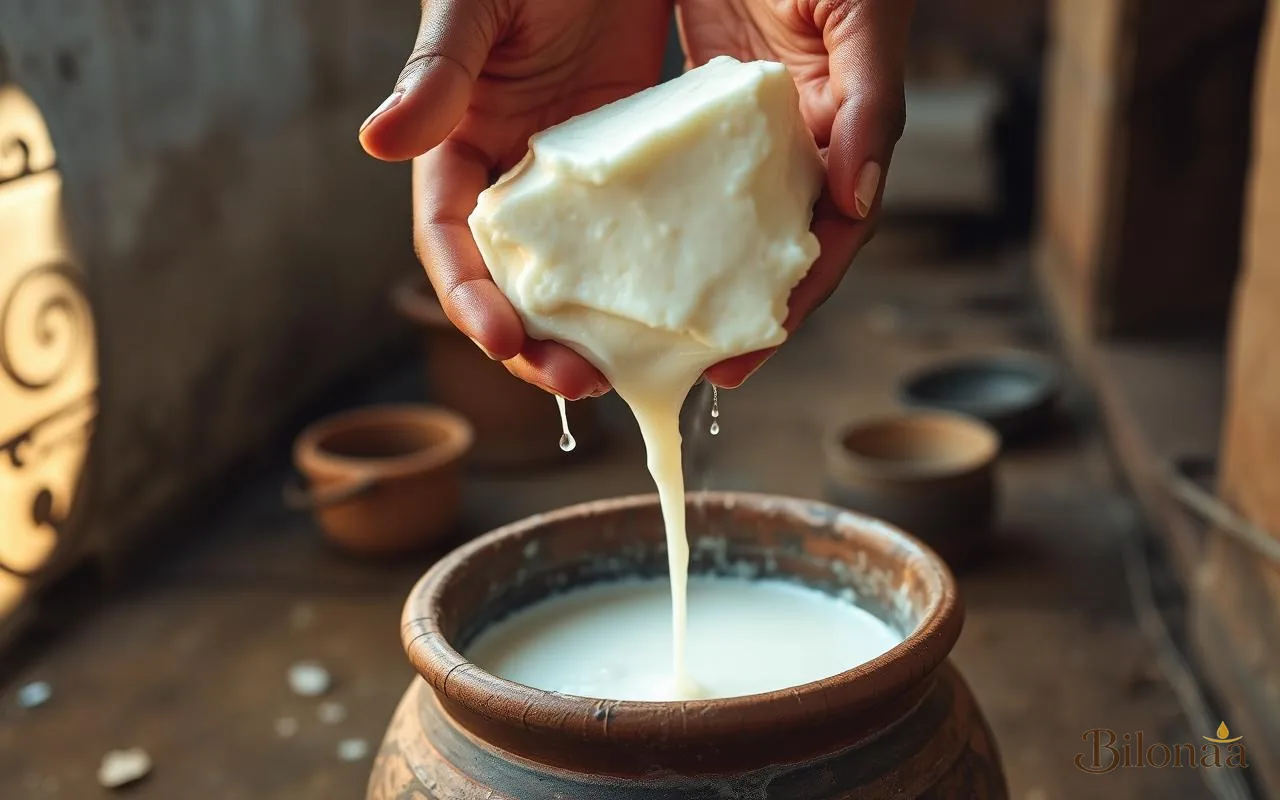
Gathering the fresh makkhan leaves behind probiotic buttermilk, ensuring zero waste in the traditional Rajasthani kitchen. Hand-scooped from the top of the churner, the raw butter is rinsed in cold water to remove residual buttermilk bits that might scorch during boiling. The remaining rich chaach is set aside for daily drinking or spiced drinks, while the gathered white makkhan sits briefly to drain excess moisture. Washing the cultured butter thoroughly is what keeps the final cooked ghee sweet and free from premature sourness.
Clarifying the washed makkhan over a low wood fire transforms raw fat into aromatic, golden liquid. The white butter is placed inside a heavy iron kadhai resting over mild heat from cow dung cakes or dried firewood. As the pan warms, the butter melts into a foaming yellow bath, gently releasing steam as water evaporates. Constant moderate heat ensures milk solids settle to the bottom without burning, slowly browning into a nutty residue that infuses the oil with a warm roasted aroma.
Straining the golden ghee through fine cloth into glass jars allows it to settle into its classic daanedaar texture. Once the bubbling stops and the liquid turns clear golden, the kadhai is taken off the fire to cool down slightly. The liquid passes through layered cotton fabric into clean glass containers or traditional stainless steel containers to filter out tiny caramelized solids. As it cools slowly in room temperature, natural fatty acid crystals grow, creating the signature grainy texture that defines pure handmade ghee.
Understanding the science behind curd-churned ghee explains why it digests much better than direct cream-derived fats. Fermentation reduces milk sugars and alters lipid structures, creating short-chain and medium-chain fatty acids like butyric acid. These smaller fatty acid chains are quickly absorbed by the intestinal lining for steady energy rather than sitting heavy in the stomach. Additionally, slow simmering under low temperatures prevents fat oxidation, leaving key fat-soluble vitamins intact alongside natural antioxidant compounds.
Ayurveda regards bilona ghee made from fermented curd as a balancing substance that nourishes deep bodily tissues. Classical texts classify curd-churned ghee as a sattvic food that supports digestive fire, known as agni, without aggravating pitta or kapha when consumed thoughtfully. It is traditionally believed to soothe internal dryness, lubricate joint tissues, and enhance the absorption of herbal nutrients. Many families find that adding a spoonful of warm bilona ghee to morning meals brings a steady feeling of comfort throughout the day.
Bringing bilona ghee into everyday Indian cooking turns simple dal tadka and phulkas into wholesome meals. A single spoon added over hot khichdi or folded into freshly rolled rotis releases an intoxicating nutty aroma that factory butter cannot replicate. Because of its high smoke point, bilona ghee stays stable during high-heat stir frying, roasting, and tempering whole spices in a hot kadhai. The natural grains melt instantly on hot food, coating grains of rice with smooth richness that elevates simple ingredients.
Comparing traditional bilona ghee to modern cream-boiled ghee reveals sharp differences in taste, aroma, and structure. Direct cream ghee is produced by skimming fresh milk cream through mechanical separators and boiling it immediately at high heat, skipping dahi culturing entirely. This quick method yields flat, oily ghee that lacks complexity and often requires artificial flavor enhancers to mimic authentic traditional aromas. True bilona ghee features a layered, roasted aroma, a distinct daanedaar grain, and a balanced mouthfeel that never leaves a greasy film.
Deciding who benefits most from bilona ghee comes down to lifestyle, digestion, and daily cooking needs. Individuals who experience heaviness after eating standard store-bought butter often report easier digestion with cultured bilona fat due to minimal lactose traces. Active individuals, growing children, and older adults seeking nutrient-dense traditional foods find it a comforting addition to daily meals. Anyone wanting to cook with unrefined, minimally processed kitchen staples will appreciate the purity and heritage behind every batch.
Dispelling common myths about bilona ghee helps clear up confusion around weight gain and shelf life. A common misconception is that all ghee causes rapid weight gain, yet moderate intake of short-chain fatty acids actually aids natural satiety. Another myth suggests that real ghee must be refrigerated to prevent spoiling, whereas low moisture content keeps pure bilona ghee shelf-stable for months at room temperature. Far from being an outdated luxury, traditional ghee remains a functional culinary fat perfectly suited for modern kitchens.
Checking for asli bilona ghee at home requires simple temperature tests rather than complex lab equipment. Put a spoonful of ghee in your palm; pure bilona ghee starts melting naturally from body warmth within seconds. Another reliable check is heating a small spoon in a kadhai; genuine bilona ghee melts immediately and turns dark golden-brown, whereas adulterated fats with palm oil or vanaspati melt slowly and stay pale yellow. Looking out for suspicious milawat helps protect your kitchen from synthetic chemical additives.
Understanding why bilona ghee costs significantly more than store-bought yellow butter ghee requires looking at milk yields. It takes roughly 25 to 30 liters of pure A2 cow milk to extract just one liter of authentic bilona ghee through the curd-churning process. When you factor in the care of native breeds, manual wood-churning time, slow wood-fire cooking, and small-batch limits, the value becomes obvious. Lower-priced commercial ghees cut costs by using high-yield factory cream, synthetic enzymes, and fast high-heat processing.
Staying true to these traditional steps in Bikaner is how our family at Bilonaa prepares small batches of pure A2 ghee. We sour fresh A2 milk from native Rathi and Tharparkar cows into dahi, churn it using wooden bilonas, and gently clarify the raw makkhan over low wood fires. Packed carefully in glass jars and sturdy steel dolchis, our ghee carries the FSSAI license 22226025000262 as a sign of complete purity. Every batch honors the timeless methods passed down through generations of Rajasthani dairy craft.
Storing your bilona ghee properly ensures that its grainy texture and nutty aroma remain fresh for months without refrigeration. Always use a clean, dry spoon to scoop ghee from the jar, as any introduced moisture can spoil the oil over time. Keep the container sealed in a cool, dark kitchen cabinet away from direct sunlight and stove heat to maintain its natural stability. With simple daily care, authentic bilona ghee retains its full flavor, rich aroma, and wholesome nourishment down to the very last grain.
"Real bilona ghee is not manufactured in a hurry; it is cultured overnight, churned with patience, and finished over a quiet fire."
Bilonaa Promise
Small-batch, A2 desi-cow, traditional bilona ghee — straight to your kitchen.
100% pure, hand-churned, slow-cooked on a wood fire and packed in glass jars.
FAQs
Quick answers
What makes the Bilona method different from regular ghee making?
Regular ghee is made by boiling fresh cream separated mechanically from milk. The Bilona method cultures whole A2 milk into curd first, churns that curd bi-directionally with a wooden pole to gather makkhan, and then simmers it slowly on a fire.
How many liters of milk are needed for one liter of Bilona ghee?
It takes approximately 25 to 30 liters of fresh A2 cow milk to produce a single liter of pure Bilona ghee, which explains its higher cost compared to industrial cream ghee.
Is Bilona method ghee suitable for lactose-intolerant people?
Because the milk is fermented into dahi and the milk solids are fully clarified during slow boiling, lactose and casein levels drop to near zero, making it widely tolerable for many families.
Why does Bilona ghee have a grainy or daanedaar texture?
The grainy texture forms naturally when ghee cools slowly at room temperature after wood-fire simmering. The fatty acids crystallize evenly, creating distinct granules without synthetic cooling or additives.
Does authentic Bilona ghee need to be stored in the fridge?
No, pure Bilona ghee has virtually no water content, allowing it to stay fresh at room temperature for months. Keep it in a dry glass jar away from moisture and direct sunlight.
How can I test if my Bilona ghee is pure at home?
Place a little ghee on your palm; authentic ghee melts quickly from body heat. Alternatively, melt a spoon in a hot pan—asli ghee turns dark brown quickly, whereas adulterated ghee stays pale.
Educational content only — please consult a doctor for medical conditions.
Get gentle ghee notes in your inbox
One thoughtful Ayurveda + kitchen note a week. No spam. Unsubscribe anytime.
Conversation(0)
Share a thought — every comment is read before it appears.