Ghee recipes
Dal Baati Churma at Home: Where and How to Use Ghee
On this page
- Where Ghee Goes in Dal Baati Churma
- Ingredients and Preparation
- Recipe timing and equipment
- For the dal
- For the baati
- For the churma
- Step 1: Cook the Dal Until Completely Tender
- Step 2: Make and Bake the Baati
- Work the ghee into the flour first
- Shape evenly and check the centre
- Add finishing ghee while the baati is warm
- Step 3: Make Baked Churma
- Step 4: Prepare the Ghee Tadka
- Serving, Troubleshooting and Choosing Ghee
- Bring the three components together
- Choose ghee for its source and cooking character
- Conclusion
A good plate of dal baati churma brings together three different textures: savoury dal, firm baked baati that breaks into crumbs, and sweet, sandy churma. Ghee connects them, but it does a different job in each component. Adding everything at the end cannot replace working some ghee into the dough or using it carefully for tadka.
This dal baati churma recipe is designed for a home oven and serves four. It uses measured spoonfuls rather than a large dipping pot, while keeping the familiar pleasure of warm baati with melted ghee. Family recipes across Rajasthan differ; this is a practical home version, not a claim that there is only one correct method.
Where Ghee Goes in Dal Baati Churma
There are five useful points for adding ghee: baati dough, baked baati, dal tadka, churma dough and finished churma. In the doughs, ghee acts as moyan, helping create a shorter, crumbly texture. In tadka, it carries the flavour of cooked spices. Added after baking, it coats exposed crumbs and brings its aroma directly to the plate.
For this four-person recipe, set aside 12 tablespoons of ghee: four for baati dough, two for finishing baati, two for dal tadka, two for churma dough and two for finishing churma. Using a standard 15 ml tablespoon, that is 180 ml for the whole recipe, excluding optional additions. These are cooking quantities, not daily intake recommendations.
If you prefer less ghee, reduce the finishing spoonfuls first rather than removing most of the moyan. Keep a little warm ghee on the table so each person can decide whether to add more. Baati does not need to sit in a pool of ghee to be enjoyable.
Ingredients and Preparation
Recipe timing and equipment
Allow approximately 90 minutes, including soaking, resting and baking, with some tasks running together. You will need a pressure cooker, oven or OTG, baking tray, small tadka pan and mixer-grinder. Use a standard 240 ml measuring cup and level spoon measures. The recipe makes eight medium baati and a small bowl of churma for sharing.
For the dal
Measure one cup of mixed dry dal: half a cup toor dal, one-quarter cup split yellow moong dal and one-quarter cup chana dal. You will also need three cups water initially, half a teaspoon turmeric and salt to taste. Keep extra hot water ready to adjust the cooked dal.
For the tadka, keep two tablespoons ghee, one teaspoon cumin seeds, a small pinch of hing, three chopped garlic cloves if using, one teaspoon grated ginger, one chopped green chilli, one medium chopped tomato, one teaspoon coriander powder and half a teaspoon red chilli powder. Finish with chopped coriander and lemon juice to taste.
For the baati
Use two cups whole-wheat atta, four tablespoons melted but lukewarm ghee, half a teaspoon salt and half a teaspoon ajwain, if liked. Keep approximately half to three-quarters of a cup water ready, adding only as much as needed. Reserve another two tablespoons ghee for the baked baati.
For the churma
Use one cup whole-wheat atta, two tablespoons melted but lukewarm ghee, a pinch of salt and roughly one-quarter to one-third of a cup water. For finishing, keep two tablespoons ghee, one-third cup powdered sugar, one-quarter teaspoon cardamom powder and two tablespoons chopped almonds or cashews, if desired. Adjust sweetness after tasting.
Step 1: Cook the Dal Until Completely Tender
Wash the three dals and soak them together for 30 minutes. Drain, then put them in the pressure cooker with three cups fresh water, turmeric and salt. Follow your cooker's instructions; soaked dal often needs around 10–15 minutes at pressure, but timing varies with the cooker and the age of the pulses.
Allow the pressure to release naturally before opening. Check the chana dal carefully: it should mash easily between a spoon and the side of the cooker. If it remains firm, cook it further. Lightly whisk the dal, leaving some texture, and add hot water until it is thick but pourable.
Simmer uncovered for five minutes after adjusting the water. Dal thickens as it stands, so avoid reducing it to a paste. It needs enough liquid to mingle with broken baati on the plate.
Step 2: Make and Bake the Baati
Work the ghee into the flour first
Preheat the oven to 190°C using conventional heat. Mix atta, salt and ajwain, then rub in four tablespoons of lukewarm ghee with your fingertips. The flour should look evenly sandy, and a squeezed handful should briefly hold together. This distribution matters more than simply pouring ghee over the finished dough.
Add water gradually and bring the mixture into a firm dough. It should hold together without feeling wet or sticky. Do not knead it for several minutes as you might for soft roti dough. Cover and rest for 20 minutes, allowing the flour to absorb the water.
Shape evenly and check the centre
Divide the dough into eight equal portions. Roll into balls, flatten slightly and press a shallow indentation into the top of each. Keep the pieces roughly the same size so they bake evenly. Small surface cracks are acceptable; deep splits suggest the dough needs a little more water.
Arrange on a lined baking tray with space between them. Bake for approximately 35–45 minutes, turning halfway, until golden and firm. Ovens vary, so split one baati to check the centre. It should have a cooked, crumbly interior without a damp, sticky or raw-looking core.
If the outside colours before the centre cooks, lower the temperature slightly and continue baking. Ghee cannot correct an undercooked centre. Equally, leaving baati in the oven long after it is cooked can make it unnecessarily dry.
Add finishing ghee while the baati is warm
Once the baati is cool enough to handle, crack each piece open with a spoon or clean cloth protecting your hands. Divide the reserved two tablespoons of warm ghee among the eight pieces, directing it into the cracks. Opening the baati exposes the crumb; brushing only the shell leaves most of the ghee outside.
Step 3: Make Baked Churma
Traditional churma methods vary, and some use fried dough pieces. This version uses separately baked, unsweetened discs, making it easier to manage alongside the baati. A separate dough also keeps ajwain and the baati's salt level out of the sweet dish.
Rub two tablespoons ghee into one cup atta and a pinch of salt. Add water gradually to make a firm dough, then rest for 15–20 minutes. Form four flattened discs about 1.5 cm thick. Bake at 190°C for approximately 25–35 minutes, turning halfway, until golden and cooked through. They can share the oven with the baati if there is enough space.
Cool until comfortable to handle, break into pieces and pulse briefly in a mixer-grinder. Aim for coarse, even crumbs rather than a fine powder. If the centre of a piece feels damp or looks raw, return it to the oven before grinding.
Mix the crumbs with two tablespoons warm ghee. Let them cool to lukewarm before adding powdered sugar, cardamom and optional nuts. Rub gently between your fingers to distribute everything. The result should be loose and sandy, not a sticky mass. Taste before adding more sugar or ghee.
Step 4: Prepare the Ghee Tadka
Heat two tablespoons ghee in a small pan over medium heat. Add cumin and let it sizzle, then add hing, garlic if using, ginger and green chilli. Stir until the garlic is lightly golden, not dark brown. Add tomato and cook until softened, taking care as it may splutter.
Lower the heat and add coriander powder and red chilli powder. Stir briefly, then add a spoonful of cooked dal to stop the powdered spices from scorching. Pour the mixture into the dal, simmer for two to three minutes, and finish with coriander and lemon juice to taste.
Ghee should be hot enough for the cumin to sizzle, but it need not smoke. If the spices turn black or smell acrid, make a fresh tadka rather than mixing bitterness into the whole pot.
Serving, Troubleshooting and Choosing Ghee
Bring the three components together
Serve the dal hot, the baati freshly cracked and the churma separately. Break a little baati into the dal as you eat rather than soaking every piece in advance. Onion wedges, lemon and a small portion of chutney make useful accompaniments without adding another complicated dish.
If baati is hard throughout, check whether the dough was too dry, the moyan was reduced sharply or the baking ran too long. If churma feels greasy, stop adding ghee and mix in extra plain baked crumbs if available. If dal feels heavy and pasty, loosen it with hot water before serving.
Choose ghee for its source and cooking character
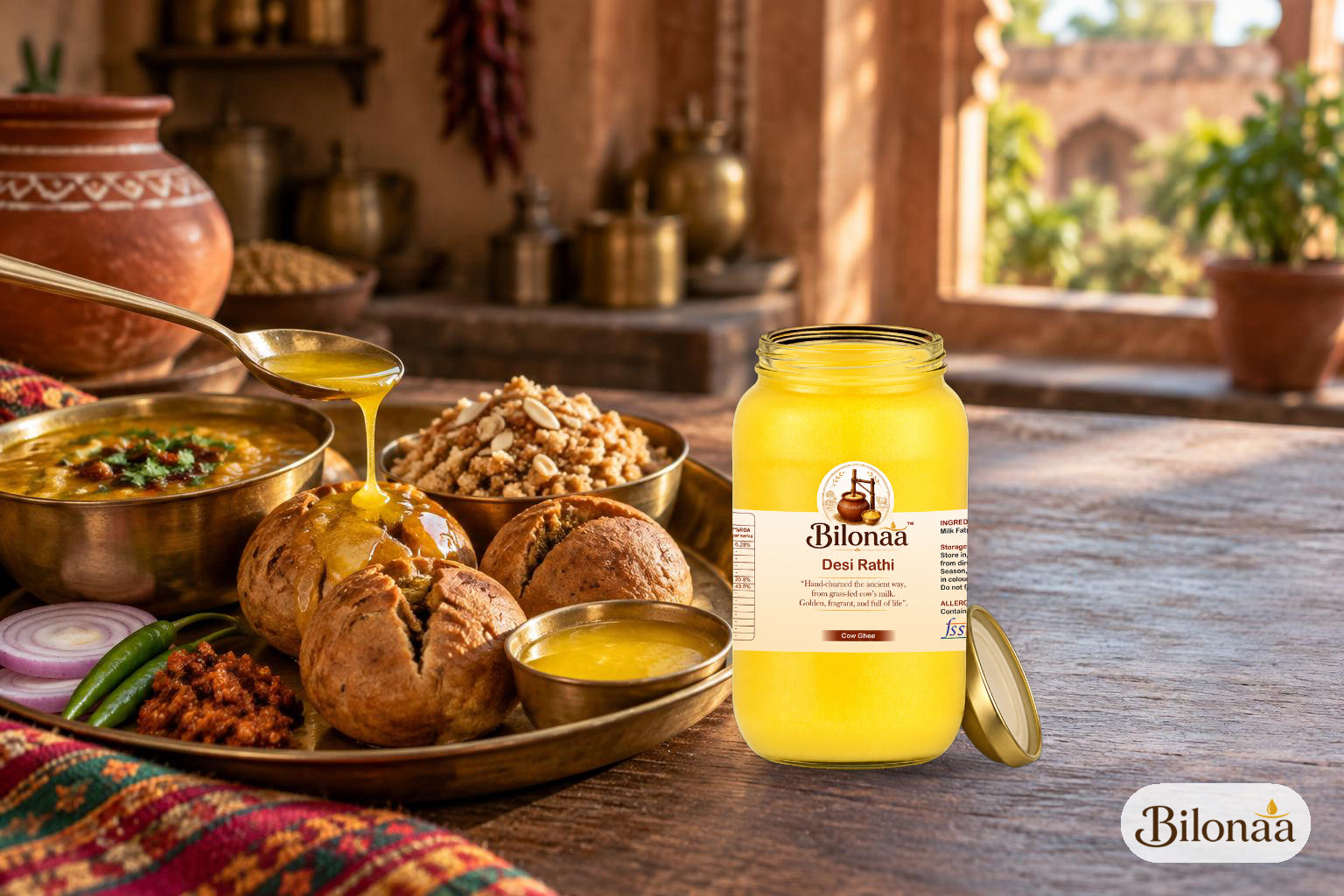
For households that prefer traditionally churned desi cow ghee, Bilonaa offers bilona A2 ghee from Bikaner, Rajasthan. Its Bilona A2 Rathi Cow Ghee can be used at all five stages here; you do not need a different ghee for the tadka and the finishing spoonfuls.
When buying, look for clear ingredient and process information rather than treating colour, graininess or a strong aroma as proof of purity. The bilona method traditionally involves churning cultured curd to obtain makhan, which is then heated to make ghee. For this recipe, careful quantities and temperature control remain important whichever ghee you choose.
Refrigerate leftover dal and baati promptly, within two hours, in separate covered containers. In very hot conditions above 32°C, refrigerate within one hour. Reheat dal thoroughly with a splash of water and warm baati separately. Keep churma airtight once completely cool; refrigerate it if preparing ahead rather than assuming homemade sweets can stay out indefinitely.
Conclusion
The key to a satisfying dal baati churma recipe is placing ghee where it helps: evenly through the dough, gently around the tadka spices, inside warm cracked baati and through the finished churma. Start with measured amounts, check doneness carefully and leave extra finishing ghee optional.
For your next Rajasthani lunch at home, explore Bilonaa's traditionally churned ghee and choose a jar that suits your kitchen.
Bilonaa Promise
Small-batch, A2 desi-cow, traditional bilona ghee — straight to your kitchen.
100% pure, hand-churned, slow-cooked on a wood fire and packed in glass jars.
FAQs
Quick answers
How much ghee is needed for dal baati churma for four people?
This recipe uses 12 tablespoons, or 180 ml with a standard 15 ml tablespoon, across all three components. Four tablespoons go into baati dough, two onto baked baati, two into dal tadka, two into churma dough and two into finished churma. Extra ghee at the table is optional.
Do I have to dip baati in ghee?
No. Dipping is a familiar serving method, but you can crack warm baati and spoon measured ghee into the exposed crumb instead. This distributes it more effectively than brushing only the outer crust.
Can I make churma from leftover baati?
Yes, if the baati is fully cooked and has been stored safely. Plain baati works best because ajwain and stronger seasoning will carry into the churma. Warm it, let it cool enough to handle, grind into crumbs and adjust ghee and sugar gradually.
Why is my baati brown outside but raw inside?
The pieces may be too large or the oven too hot. Make evenly sized, slightly flattened baati and bake at a moderate temperature. If they colour early, lower the heat and continue cooking until a split baati has no damp, raw-looking centre.
When should sugar be added to churma?
Add powdered sugar after the cooked crumbs and finishing ghee have cooled to lukewarm. Mixing sugar into very hot crumbs can make the mixture sticky rather than loose and sandy.
Educational content only — please consult a doctor for medical conditions.
Get gentle ghee notes in your inbox
One thoughtful Ayurveda + kitchen note a week. No spam. Unsubscribe anytime.
Conversation(0)
Share a thought — every comment is read before it appears.