
Cow Breeds
The Economics of Calf-First Dairy: What Ethical Milk Really Costs
On this page
- The sticker price of artisanal ghee often surprises consumer
- Understanding dairy economics in India requires examining th
- Indigenous breeds such as Gir, Sahiwal, Rathi, and Tharparka
- The core ethical commitment in calf-first dairy management b
- An illustrative operational model demonstrates how leaving m
- Feed and forage represent the single largest recurring opera
- | Operational Component | Intensive Commercial Model | Calf-
- Regional ecology plays a massive role in forage availability
The sticker price of artisanal ghee often surprises consumers accustomed to industrial dairy commodities. In retail markets across India, standard commercial ghee sells for relatively low prices per litre, while small-batch cultured butter clarified using traditional methods commands a significant premium. This price gap is not merely a branding artifact; it stems from fundamentally distinct economic models of milk production, animal welfare, and processing methods. Commercial operations achieve low unit costs through high-volume crossbred cattle, mechanized extraction, and intensive feedlots. Artisanal producers, by contrast, operate under severe yield constraints driven by native breed genetics, calf-first feeding protocols, and manual processing.
Understanding dairy economics in India requires examining the fundamental split between high-yield hybrid cows and native indigenous breeds. Exotic crossbreeds like Holstein-Friesian or Jersey were introduced in earlier decades to maximize liquid milk output, often yielding 25 to 40 litres daily under high-input stall-feeding regimes. Conversely, Bos indicus (desi) breeds naturally yield substantially less volume, typically averaging between 6 to 12 litres per day. This inherent biological yield differential creates the primary economic baseline for Indian milk production. Choosing to raise indigenous cattle immediately reduces total sellable volume per animal, establishing a baseline cost per litre that is inherently higher.
Indigenous breeds such as Gir, Sahiwal, Rathi, and Tharparkar possess genetics honed over centuries for climate resilience rather than maximum liquid volume. These native animals thrive in extreme heat, adapt to local vegetation, and display robust immunity against regional pathogens. However, their metabolic energy goes toward maintaining body condition, heat tolerance, and milk quality rather than high fluid volume. For smallholders practicing ethical dairy farming in India, keeping native cattle preserves invaluable genetic biodiversity. Yet, because each cow produces a modest daily quantity, every single litre must carry a larger proportion of the herd's overall upkeep expenses.
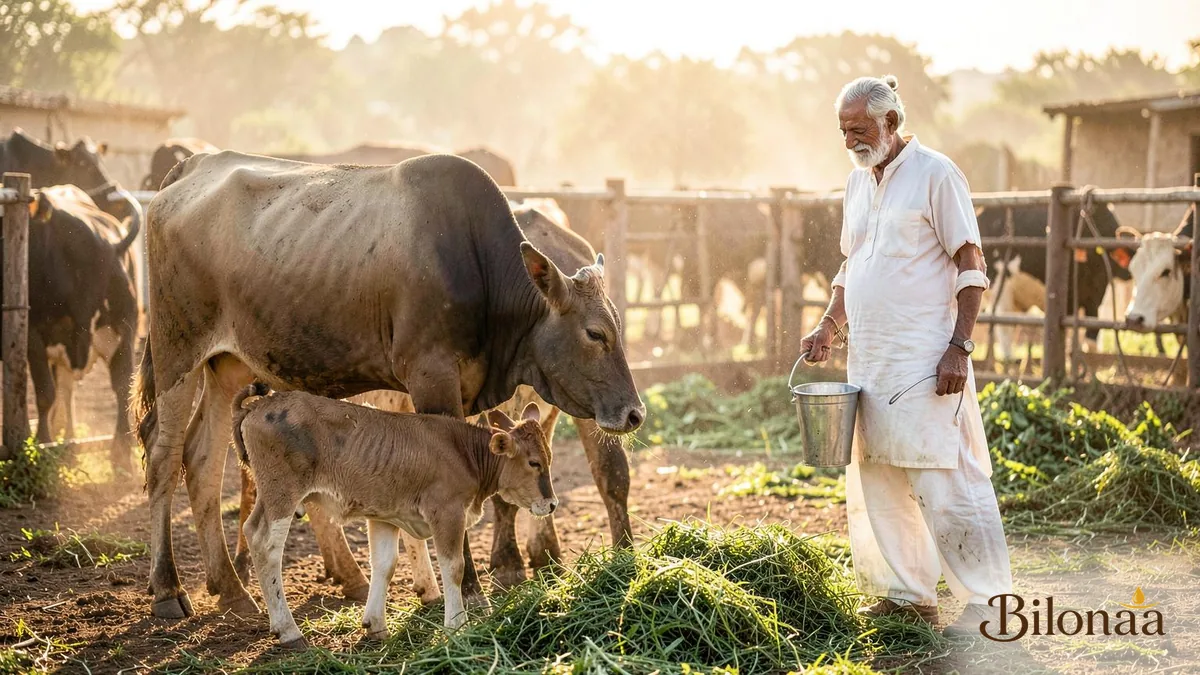
The core ethical commitment in calf-first dairy management begins with allocating a substantial portion of daily milk directly to the young calf. In high-efficiency commercial operations, calves are frequently separated shortly after birth or fed milk replacement formulas so that all lactating milk can be collected for market sale. In contrast, a calf-first management system allows the young calf to nurse directly from its mother—typically taking two out of four teats—during its initial growth months. This ensures optimal calf growth, maternal bonding, and immune health, but it directly removes 30 to 50 percent of total daily milk from sellable inventory.
An illustrative operational model demonstrates how leaving milk for the calf fundamentally shifts the unit economics of a small dairy herd. Consider a hypothetical smallholding maintaining 10 lactating native cows, each producing an average of 8 litres per day. In a volume-focused system, the farm sells nearly 80 litres daily. Under an illustrative calf-first model, roughly 3 to 4 litres per cow remain reserved for the calves, leaving only 40 to 50 litres available for processing or sale. Fixed daily operating expenses—such as animal housing, water infrastructure, land maintenance, and general herd care—remain identical regardless of sellable output, practically doubling the baseline expense allocated to each marketable litre.
Feed and forage represent the single largest recurring operational expenditure for any ethical dairy farm maintaining native cattle. Indigenous cattle require a balanced diet of green fodder, dry roughage, and natural grain concentrates to support milk production and overall health. While industrial operations often utilize low-cost crop residues and synthetic protein concentrates, ethical smallholders invest in fresh green forage like lucerne, sorghum, and native grasses. The table below outlines a comparative operational breakdown contrasting intensive volume-focused milk production with an illustrative calf-first ethical farming model.
| Operational Component | Intensive Commercial Model | Calf-First Ethical Model (Illustrative) | | :--- | :--- | :--- | | Typical Daily Milk Output | 25 - 30 Litres | 8 - 10 Litres | | Milk Retained for Calf | Minimal (0 - 1 Litre) | Generous (3 - 4 Litres) | | Marketable Daily Milk | 24 - 29 Litres | 4 - 6 Litres | | Daily Feed & Fodder Cost | ₹200 - ₹250 | ₹180 - ₹220 | | Labour & Care Allocation | ₹40 - ₹60 | ₹100 - ₹140 | | Effective Cost Per Marketable Litre | ₹10 - ₹13 | ₹50 - ₹80 |
Regional ecology plays a massive role in forage availability, particularly in arid zones where natural grazing requires vast open lands. In semi-arid regions like the Thar Desert of Rajasthan, native vegetation such as Dhaman grass, Sewan grass, and desert shrubs provide nutrition for hardy cattle breeds like Rathi and Tharparkar. Sourcing or cultivating these specialized regional grasses during dry seasons requires deliberate pasture management and storage logistics. The micro-nutritional profile of pasture milk is closely tied to this natural diet, as explored in our study on [thar desert forage milk quality](/blog/thar-desert-forage-milk-quality). Maintaining pesticide-free forage throughout dry months adds significant financial consistency to farm budgets.
Labour requirements for artisanal dairy care far exceed those of mechanized commercial milking facilities. Ethical husbandry relies on individual animal care, hand milking, daily grooming, clean stall management, and open movement routines. Unlike automated milking parlours designed to process hundreds of cows per hour with minimal human intervention, small-scale traditional herds rely on experienced herdsmen who understand individual cow temperaments and health subtle signals. Paying fair, sustainable wages to rural workers represents a direct ethical investment, ensuring gentle handling that reduces animal stress and maintains herd health.
Veterinary care for indigenous breeds emphasizes preventive health and traditional husbandry over routine antibiotic administration. While Bos indicus cattle carry strong natural immunity, ethical dairy protocols avoid the prophylactic antibiotics, synthetic growth hormones, and aggressive fertility interventions commonly used in high-density commercial milk systems. Instead, farms invest in diagnostic health monitoring, herbal treatments, regular deworming, and clean living environments to manage health risks organically. Furthermore, when animals reach non-lactating stages, ethical management continues their lifetime care rather than discarding them, adding a long-term retirement expense to overall farm economics.
The transformation of fresh milk into traditional butter requires time, temperature control, and substantial energy inputs. Once fresh milk is collected, it is gently boiled, cooled, and inoculated with whole-milk curd cultures to undergo overnight fermentation. This biological step converts lactose into lactic acid, producing traditional dahi. The fermented curd is then diluted with pure water and churned using a bi-directional wooden spindle—a key element of the [traditional bilona method](/traditional-bilona-method). This process separates butter (makkhan) from buttermilk (chaas), demanding dedicated manual oversight and thermal management that cannot be bypassed with modern centrifugal cream separators.
Yield conversion math reveals why fat-dense cultured butter yields a relatively small quantity of finished clarified butter. Whole milk from native cows generally contains 4 to 5 percent natural fat content. To extract enough cultured butter to render one single litre of authentic [bilona ghee](/bilona-ghee), processing facilities require roughly 25 to 30 litres of whole fresh milk. When combined with the calf-first model where sellable milk yields are already modest, one litre of artisanal ghee reflects the cumulative daily sellable milk allocation of multiple lactating cows. This biological math explains why genuine cultured ghee cannot economically match commodity prices.
Slow cooking over traditional wood fires demands constant human oversight and precise thermal control. Collected butter is placed in heavy-bottomed brass or iron vessels and heated slowly over low flames, historically using dried cow-dung cakes or sustainably harvested firewood. This gradual heating allows residual water content to evaporate and milk solids to brown gently without burning the delicate butterfat. Skilled artisans must continuously monitor and stir the vessel to capture the exact moment when solids clarify and separate cleanly. The hand-crafted nature, fuel sourcing, and extended cooking duration stand in contrast to continuous high-pressure industrial rendering.
Packaging choices reflect a commitment to product integrity but introduce significant logistical and material expenses. Flexible plastic pouches and cheap synthetic containers offer low material costs and lightweight shipping, but they risk chemical leaching when exposed to warm fats and create non-recyclable waste. High-grade glass containers preserve flavor and lipid structure safely over long periods, but they cost significantly more to manufacture and ship. Specialized outer padding is required to prevent breakage during transit, an operational trade-off detailed in our review of [glass jar ghee carbon footprint](/blog/glass-jar-ghee-carbon-footprint).
Logistics and direct-to-consumer courier networks add a final layer of fixed expense to fragile food shipments. Transporting heavy glass containers filled with artisanal oils across India requires specialized courier partners, thick double-walled corrugated outer boxes, and protective cushioning materials. Shipping costs for individual glass packages are substantially higher per unit than bulk commercial freight distributed via regional supermarket supply chains. Insurance and breakage protection further add to direct fulfillment costs, ensuring that delicate jars arrive intact without compromising product quality.
Ayurvedic texts historically contextualize ghee not as a mass commodity but as a precious food requiring deliberate craft. Classical medical literature like the Charaka Samhita describes ghrita prepared from whole-milk cultured butter as a nourishing substance designed to support vitality when prepared correctly. Crucially, these historical texts place strong emphasis on the wellbeing, freedom, and dietary health of the cow as a fundamental prerequisite for quality milk. In traditional wellness philosophy, the energy and care invested in sustainable animal husbandry directly influence the subtle qualities of the final product.
Scientific research evaluating dairy farming economics highlights the real trade-offs between intensive production and sustainable husbandry. Agricultural economics studies indicate that while high-input commercial dairy systems achieve impressive short-term volume efficiency, they frequently face rising expenses related to veterinary interventions, reproductive disorders, and shorter total cow lifespans. Conversely, indigenous cattle systems display lower annual fluid yields but demonstrate longer productive lifespans, greater disease resistance, and overall climate resilience. Economic literature acknowledges that pricing models for native breed products must reflect these distinct structural cost curves to maintain economic viability for small farmers.
Current empirical evidence regarding specific nutritional differences between ethical pastured milk and standard commercial milk remains nuanced and context-dependent. Controlled biochemical analyses confirm that pasture-fed cattle milk generally contains higher proportions of conjugated linoleic acid (CLA) and omega-3 fatty acids compared to grain-fed stall-kept animals. However, clinical human trial data comparing direct, long-term health outcomes between drinking standard milk versus ethically raised pasture-fed milk is currently limited. Communicating these facts clearly helps readers distinguish verified fatty acid profiles from unsubstantiated marketing claims.
At Bilonaa, situated in the heritage landscape of Bikaner, we honor these traditional principles by producing authentic [A2 cow ghee](/a2-cow-ghee) in small batches. Our commitment to gentle churn methods and slow wood-fire cooking reflects our belief in transparent food craft, as outlined in [our story](/about). We invite you to explore our traditional processes, discover our product range, or review our detailed [FAQs](/faq) to understand how traditional dairy ethics shape every jar we offer.
"When a farm allows a calf to nurse first, it prioritizes long-term animal health over immediate yield—fundamentally reshaping the economics of traditional dairy."
Bilonaa Promise
Small-batch, A2 desi-cow, traditional bilona ghee — straight to your kitchen.
100% pure, hand-churned, slow-cooked on a wood fire and packed in glass jars.
FAQs
Quick answers
Why does ethical calf-first ghee cost significantly more than standard commercial ghee?
Ethical ghee costs more because it uses milk from native Indian cows that yield significantly less volume than commercial crossbreeds. Additionally, 30 to 50 percent of the milk is left for the calf to nurse. Combined with the 25 to 30 litres of milk required for one litre of bilona ghee, production costs are inherently higher.
How much milk does a calf typically drink in a calf-first system?
In a calf-first system, calves nurse directly from two out of four teats of the mother. This allows the calf to consume between 30 and 50 percent of the cow's daily milk yield during its primary growth period, prioritizing animal health over maximum harvest.
What is the yield difference between native Indian cows and commercial hybrid cows?
Native Bos indicus breeds (such as Gir, Rathi, or Sahiwal) typically yield 6 to 12 litres of milk daily. Commercial crossbreeds (such as Holstein-Friesian or Jersey) are bred for high fluid volume and can yield 25 to 40 litres daily under intensive conditions.
How many litres of milk are needed to make one litre of bilona ghee?
It takes approximately 25 to 30 litres of whole fresh native cow milk to produce one litre of traditional bilona ghee. This is because the process relies on churning whole-milk curd into butter before slow-clarifying, rather than separating cream directly.
Why are glass jars preferred over plastic containers for traditional ghee packaging?
Glass jars are non-reactive, non-porous, and completely free from chemical leaching risks, preserving the pure aroma and fat stability of ghee. While glass increases packaging and transit costs due to weight and fragility, it guarantees long-term product integrity.
Are there proven scientific differences in milk from pasture-fed native cows?
Biochemical studies show that pasture-fed cows produce milk higher in omega-3 fatty acids and conjugated linoleic acid (CLA) compared to grain-fed cattle. However, clinical human research on direct long-term health differences remains limited and ongoing.
Educational content only — please consult a doctor for medical conditions.
Get gentle ghee notes in your inbox
One thoughtful Ayurveda + kitchen note a week. No spam. Unsubscribe anytime.
Conversation(0)
Share a thought — every comment is read before it appears.