Ghee recipes
Gajar Halwa with Ghee: When to Add It, Without the Grease
On this page
- When Should You Add Ghee to Gajar Halwa?
- How Much Ghee Do You Need?
- Does bilona ghee change the quantity?
- Gajar Halwa Recipe with Ghee: Ingredients and Preparation
- Step-by-Step Method for a Moist, Non-Greasy Finish
- 1. Toast the nuts and briefly sauté the carrots
- 2. Add milk and simmer until the carrots are tender
- 3. Add sugar and reduce the loosened mixture
- 4. Add the remaining ghee gradually
- 5. Add cardamom, rest and serve
- Why Gajar Halwa Turns Greasy
- Adding more ghee whenever the pan sticks
- Forgetting the fat in other ingredients
- Cooking until all moisture disappears
- Pouring ghee over each serving
- How to Fix Greasy, Dry or Watery Halwa
- Storing and Reheating Without Extra Grease
- Conclusion
A bowl of warm gajar halwa should taste of sweet carrots, reduced milk and fragrant ghee. It should not leave a puddle of fat beneath the spoon. Yet that greasy finish is easy to create, especially when we keep adding ghee because the halwa looks dry or has started sticking.
The key to a dependable gajar halwa recipe with ghee is to manage moisture first and fat second. Add a little ghee at the beginning if you enjoy that sautéed flavour, then add most of it after the carrots have softened and the milk and sugar liquid have largely reduced. Here is a practical method with clear visual cues.
When Should You Add Ghee to Gajar Halwa?
For the milk-based method below, add ghee in two stages: a small amount to briefly sauté the grated carrots, followed by the larger portion near the end. The second addition comes after the milk has reduced, the sugar has dissolved and the resulting loose liquid has mostly cooked away.
This is not the only traditional approach. Some households simmer carrots directly in milk and add all the ghee towards the end. That works too. What matters more than the exact sequence is avoiding repeated, unmeasured additions while the halwa is still watery or already oily.
Look for a moist, thick mixture before the main ghee addition. When you draw a spatula across the bottom of the kadai, the path should remain visible briefly rather than immediately filling with milky liquid. The carrots should be tender, not firm strands floating in milk.
How Much Ghee Do You Need?
For this recipe, start with 3 level tablespoons of ghee for 1 kg of prepared carrots and 1 litre of full-fat milk. This is a cooking guideline for a moderately rich homemade halwa, not a fixed rule for every recipe. Milk richness, added khoya and personal preference all affect the result.
Use measuring spoons rather than a serving spoon: 1 tablespoon means 15 ml. Measure liquid or softly melted ghee so that a heaped scoop of firm ghee does not quietly increase the quantity. Set the measured amount aside before cooking.
If you add khoya, cream or condensed milk, reassess the ghee rather than automatically using the full amount. These ingredients change the recipe's richness and moisture balance; condensed milk also adds sweetness. The base recipe below needs none of them.
Does bilona ghee change the quantity?
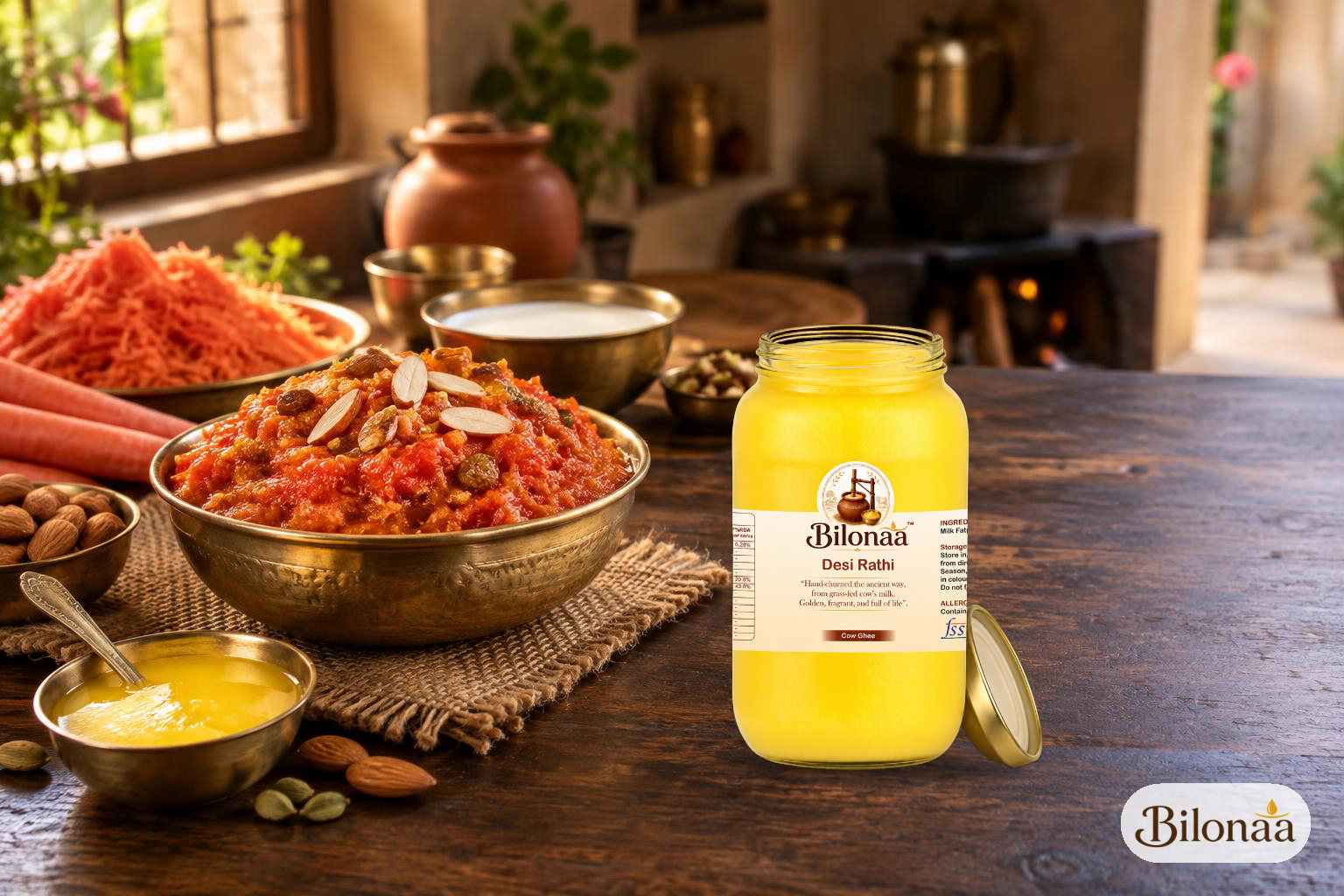
Traditionally made bilona ghee can be chosen for its making process and flavour, but it does not prevent greasiness when too much is used. Bilonaa makes traditionally churned bilona A2 desi cow ghee in Bikaner, Rajasthan. Use it with the same measured approach: the aim is to complement the carrots, not cover them.
Gajar Halwa Recipe with Ghee: Ingredients and Preparation
This batch serves roughly 6–8 people, depending on portion size. Allow about 20 minutes for preparation and 50–75 minutes for cooking, though the width of your pan, heat level and carrot moisture can change the timing considerably. Follow the texture cues rather than the clock alone.
You will need 1 kg carrots, weighed after trimming and peeling; 1 litre full-fat milk; 150–180 g sugar, according to carrot sweetness; 3 level tablespoons ghee; ½ teaspoon ground cardamom; and 2–3 tablespoons chopped almonds or cashews, if desired.
Choose fresh, firm carrots. Red winter carrots are a familiar choice, but orange carrots work as well. Grate them medium-fine: very coarse strands take longer to soften, while an extremely fine grate can produce a pastier texture. Remove any noticeably tough, woody core.
Use a wide, heavy-bottomed kadai or pan and a sturdy spatula that can scrape its base and corners. A wide pan helps liquid evaporate; a heavy base makes the later, thicker stage easier to manage without scorching.
Step-by-Step Method for a Moist, Non-Greasy Finish
1. Toast the nuts and briefly sauté the carrots
If using nuts, dry-toast them gently in the kadai and set them aside. This avoids adding an extra, uncounted spoon of ghee for frying them. Keep the heat low enough that they colour lightly without burning.
Add 1 tablespoon of the measured ghee to the pan, followed by the grated carrots. Cook on medium-low heat for about 4–5 minutes, stirring well. You want the carrots lightly coated and beginning to soften, not browned or fried crisp.
2. Add milk and simmer until the carrots are tender
Pour in the milk and bring it to a gentle simmer. Cook uncovered, stirring regularly and scraping the bottom. As the milk reduces, stir more frequently because the thickening milk solids can catch.
Let the carrots become tender before adding sugar. Taste a cooled strand to check: it should no longer have a firm, raw centre. The milk should be mostly reduced, leaving the carrots moist and creamy rather than swimming in liquid.
3. Add sugar and reduce the loosened mixture
Stir in 150 g sugar initially. The mixture will usually loosen as the sugar dissolves and the carrots release more moisture. This is normal; it does not mean the halwa needs extra ghee.
Cook uncovered on medium-low heat, stirring and scraping until the loose liquid largely disappears. Taste a small cooled spoonful and add the remaining sugar only if needed, allowing any extra liquid to reduce again. Keep the mixture moist rather than drying it into a tight mass.
4. Add the remaining ghee gradually
Add 1 tablespoon of the remaining ghee and fold it through thoroughly. Cook for 2–3 minutes on low to medium-low heat. Then add the final tablespoon in smaller portions, checking the texture between additions. You can stop short if the halwa already has the finish you want.
Continue stirring gently for a few minutes, just until the halwa looks cohesive and lightly glossy. Do not wait for a large amount of ghee to separate around the edges. That familiar cue in some richer halwa styles is unnecessary for this lighter, milk-based finish.
5. Add cardamom, rest and serve
Fold in the cardamom and toasted nuts, then switch off the heat. Rest for 5–10 minutes before serving. A spoonful should hold a soft mound but separate easily when eaten. It should not sit in visible liquid or feel stiff and crumbly.
Why Gajar Halwa Turns Greasy
Adding more ghee whenever the pan sticks
Sticking may mean the heat is too high, the pan has hot spots or the milk solids need more frequent scraping. More fat will not reliably solve those problems. Lower the heat first. If the halwa has become genuinely dry, add a small splash of milk and stir gently.
Forgetting the fat in other ingredients
Full-fat milk, khoya, cream and ghee-fried nuts all contribute richness. A recipe that includes several of these may need less added ghee than a simpler version. Measure the whole recipe, including garnishes, rather than treating every finishing spoon as separate.
Cooking until all moisture disappears
Halwa needs some moisture for a soft mouthfeel. Prolonged roasting after the mixture is already thick can make it dry while leaving fat visibly separate. More cooking does not make excess ghee evaporate; it mainly removes water and may scorch the solids.
Pouring ghee over each serving
A finishing drizzle is optional, not essential. If you want that freshly warmed ghee aroma, reserve a teaspoon from the measured recipe quantity rather than adding it on top of the full amount. A subtle sheen is enough.
How to Fix Greasy, Dry or Watery Halwa
For visibly greasy halwa, stop adding fat and lower or switch off the heat. Let it settle briefly. If there is a distinct pool at the edge, carefully spoon off the accessible excess. Stir and assess a slightly cooled spoonful before deciding it needs further correction.
If the whole batch is heavily over-greased, a more effective adjustment is to fold in additional carrots cooked separately with milk, without extra ghee. This increases the batch size and dilutes the excess fat. Adjust sweetness and cardamom afterwards; it is a practical rescue, not an instant fix.
For dry halwa without pooled fat, add warm milk a tablespoon at a time over low heat. Fold it through until the texture softens, then heat thoroughly. Adding more ghee may make it slick without restoring the missing moisture.
For watery halwa, continue cooking uncovered and stir regularly. Do not add flour or extra ghee to force it to thicken. If the batch is too deep for the pan, divide it between two wide pans so the liquid can reduce more evenly.
Storing and Reheating Without Extra Grease
Refrigerate leftovers promptly in shallow, covered containers; do not leave milk-based halwa out overnight. Use within 3–4 days when kept refrigerated at 4°C or below, and reheat only the portion you plan to serve.
Cold halwa feels firmer because its fat has set. Warm it gently before judging whether it needs anything. If it remains dry, add a small splash of milk, stir and heat until steaming hot throughout. Another spoon of ghee is rarely the first thing it needs.
Conclusion
Good gajar halwa comes from tender carrots, patiently reduced milk and measured ghee. Add the main portion after the sugar liquid has reduced, stop at a gentle sheen and preserve enough moisture for a soft spoonful. You do not need a pool of fat to make halwa taste generous.
For your next batch, explore Bilonaa's traditionally churned ghee and try the measured, two-stage method. Let the carrots remain the star, with ghee bringing the final touch of aroma.
Bilonaa Promise
Small-batch, A2 desi-cow, traditional bilona ghee — straight to your kitchen.
100% pure, hand-churned, slow-cooked on a wood fire and packed in glass jars.
FAQs
Quick answers
Can I add all the ghee at the end of gajar halwa?
Yes. Simmer the carrots in milk until tender, add sugar and reduce the loose liquid, then fold in measured ghee gradually. The initial sauté is optional; use a heavy-bottomed pan and stir regularly.
Is 3 tablespoons of ghee enough for 1 kg of carrots?
It is a useful starting quantity for this recipe with 1 litre of full-fat milk. Add it gradually and judge the finish. Recipes containing khoya or cream may need less added ghee.
Should ghee separate from gajar halwa before I switch off the heat?
Not necessarily. For a moist, moderately rich milk-based halwa, tender carrots, no loose liquid and a light sheen are better cues. Waiting for a large pool of separated fat can lead to overcooking.
Can I use A2 bilona ghee in carrot halwa?
Yes. Use it as you would other cooking ghee, measuring the quantity and adding it gradually. The bilona process does not make excess ghee less greasy, so moisture control and timing still matter.
Why does my halwa look oily after reheating?
Reheating melts the fat, making any excess more visible. High heat can also dry the halwa further. Reheat gently, stir well and add a little milk only if the mixture needs moisture.
Educational content only — please consult a doctor for medical conditions.
Get gentle ghee notes in your inbox
One thoughtful Ayurveda + kitchen note a week. No spam. Unsubscribe anytime.
Conversation(0)
Share a thought — every comment is read before it appears.