
Bilonaa Method
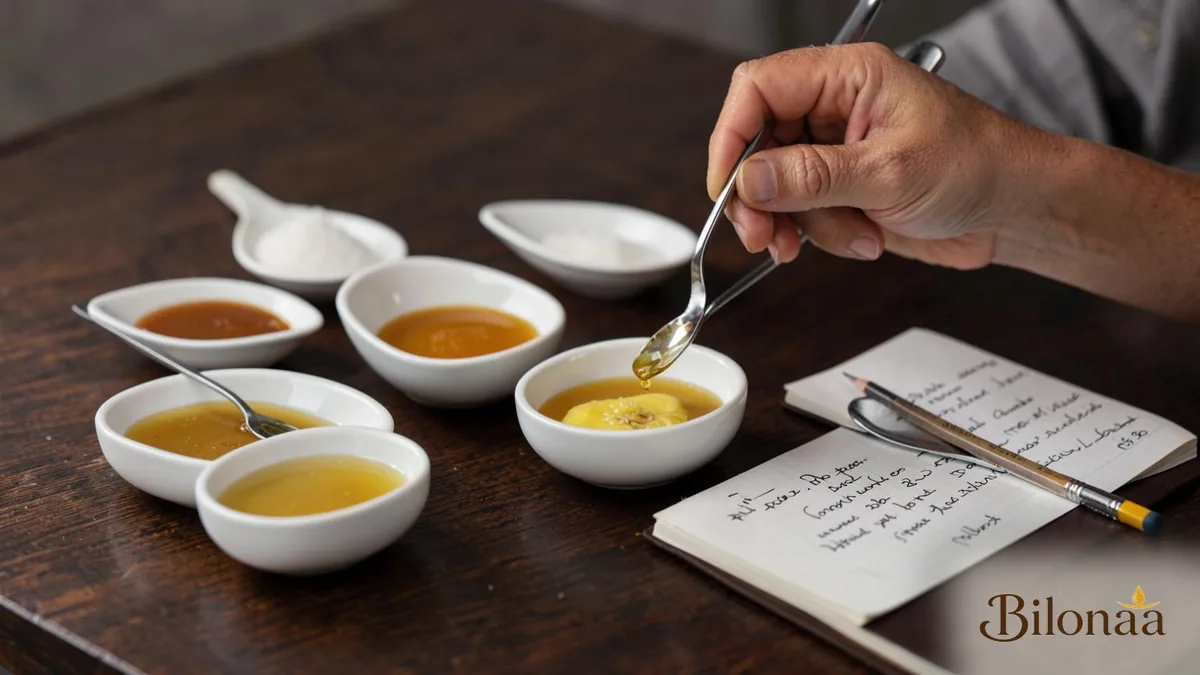
How Ghee Is Graded by Nose and Palate: Inside Sensory Evaluation
On this page
- Sensory evaluation of clarified butter relies on calibrated
- The sensory lexicon for ghee categorizes sensory attributes
- Visual grading begins with observing color uniformity, clari
- Texture profiling measures grain size, distribution, and how
- Trained sensory panels use standardized descriptive analysis
- Triangle testing allows quality managers to detect subtle ba
- Comparative evaluation highlights how different sensory meth
- Temperature regulation plays a decisive role in sensory eval
Sensory evaluation of clarified butter relies on calibrated human perception rather than subjective personal preference. In formal dairy science, sensory analysis converts organoleptic experiences—what assessors see, smell, taste, and feel—into repeatable quantitative data. Qualified evaluation panels undergo structured training to identify subtle nuances in milk fats, isolating specific sensory descriptors from background noise. Unlike informal consumer taste tests, sensory panels use standardized scoring systems and controlled environments to minimize bias. The goal is to establish a rigorous baseline for quality, ensuring that every batch meets exact structural and aromatic specifications.
The sensory lexicon for ghee categorizes sensory attributes across visual appearance, aroma profiles, tactile grain, and palatability. Dairy scientists and sensory panelists use standardized terms to describe both desirable traits and potential defects. A typical lexicon includes descriptors such as curdy, nutty, cooked, caramelized, acidic, and rancid. Establishing this common language allows panellists across different laboratories to evaluate fat samples consistently without relying on vague adjectives. By linking specific verbal descriptors to precise chemical compounds, sensory panels bridge the gap between human perception and chemical analysis.
Visual grading begins with observing color uniformity, clarity, and liquid-to-solid phase separation at controlled ambient temperatures. Panellists evaluate the color of clarification, which can range from pale cream to deep golden yellow depending on cow breed, beta-carotene concentration, and heat treatment intensity. The fat matrix is examined under standardized lighting to detect suspended sediment, charred milk solids, or unwanted turbidity. Visual inspection also checks for phase separation, where liquid oil sits atop solid crystalline fat at room temperature. Proper visual appearance provides an immediate baseline assessment before the panellist proceeds to olfactory and gustatory evaluations.
Texture profiling measures grain size, distribution, and how crystals melt under thermal friction on the tongue. In Indian dairy science, the semi-solid granular state is an essential quality parameter. Panellists evaluate the structural integrity of these crystals, taking note of whether the grain is fine, coarse, uniform, or waxy. Understanding the physical principles behind [daanedaar ghee crystals science](/blog/daanedaar-ghee-crystals-science) helps assessors evaluate how lipid crystallization behaves during storage. When placed on the tongue, the crystals should dissolve smoothly without leaving a greasy coating or abrasive grit against the palate.
Trained sensory panels use standardized descriptive analysis to quantify volatile aroma compounds without bias. Descriptive analysis involves presenting panelists with reference standards—such as isolated diacetyl, butyric acid, or lactone solutions—to calibrate their olfactory responses. Panel members rate the intensity of individual aroma notes on a numerical scale, generating a sensory profile or spider plot for the sample. This methodology allows quality assurance teams to track precise sensory shifts across production runs. By isolating individual aroma components, descriptive analysis prevents dominant top notes from masking subtle off-flavors.
Triangle testing allows quality managers to detect subtle batch variations before products leave the facility. In a classic triangle test, panellists receive three coded samples simultaneously, where two samples are identical and one is different. The panellist must identify the odd sample based strictly on sensory differences in aroma, taste, or texture. Statistical analysis of the panel's success rate determines whether a perceptible difference exists between production lots. This discrimination technique is particularly valuable when testing process modifications, packaging materials, or seasonal transitions in raw milk supply.
Comparative evaluation highlights how different sensory methodologies serve distinct quality control functions within the dairy industry. The table below outlines the primary methodologies, sample preparations, and typical objectives used by sensory evaluation panels. | Sensory Method | Sample Preparation | Primary Objective | Typical Output | | :--- | :--- | :--- | :--- | | Descriptive Analysis | Warmed liquid (35–40°C) | Quantify attribute intensity | Attribute profile / Spider chart | | Triangle Test | Blown or melted samples | Detect batch non-conformance | Statistical significance (p-value) | | Texture Profiling | Solid state (20–22°C) | Measure grain size & melt rate | Hardness & grain uniformity index | | Consumer Hedonic Testing | Untrained consumer panels | Gauge general preference | Overall acceptability score |
Temperature regulation plays a decisive role in sensory evaluation because volatile compounds release at specific thermal thresholds. Sensory evaluation of ghee is typically performed at two distinct temperatures: room temperature (22–25°C) for texture and physical appearance, and warmed liquid state (35–40°C) for olfactory assessment. Heating the liquid fat enhances the vapor pressure of volatile short-chain fatty acids, lactones, and aldehydes, allowing sniffing panels to capture delicate aromatic compounds. Panellists use specialized glass vessels designed to concentrate vapors while keeping the sample at a constant temperature. Inadequate thermal control can mute key flavor notes or falsely accentuate light volatile defects.
Chemical analysis measures objective fat purity metrics that human sensory panels cannot quantify accurately. Laboratory testing provides numerical values for parameters like Free Fatty Acid (FFA) content, moisture level, Peroxide Value (PV), and Reichert–Meissl (RM) value. While sensory panels judge flavor and mouthfeel, chemical assays measure the chemical degradation and lipid oxidation state of the fat. Moisture testing ensures the product stays below standard limits to prevent microbial growth during ambient storage. Chemical analysis acts as an essential quantitative anchor that complements sensory observations.
Comparing human sensory evaluation against standard chemical assays shows where each analytical approach provides distinct value. The table below details how sensory parameters map against standard laboratory tests for clarified butter. | Quality Metric | Sensory Evaluation Focus | Laboratory Test Equivalent | Primary Detection Limit | | :--- | :--- | :--- | :--- | | Rancidity / Oxidation | Detects cardboard, metallic off-notes | Peroxide Value (PV) & Anisidine | Pre-chemical odor detection | | Free Fatty Acids | Notes sharpness or throat prickle | Acid Value / FFA Titration | Quantitative % of free oleic acid | | Volatile Profile | Identifies nutty, cooked, or sweet notes | Gas Chromatography–MS | Chemical identity of aromatics | | Adulteration | Identifies unusual melting or body | Polenske Value & RM Value | Detection of non-bovine/vegetable fats |
Sensory testing excels at detecting off-notes long before standard chemical oxidation indicators trigger alarms. Human olfactory receptors are remarkably sensitive to volatile oxidation products such as hexanal and 2,4-decadienal. Panellists can often detect early oxidation—perceived as a faint metallic or stale cardboard note—before chemical indicators like Peroxide Value show a significant increase. This early warning capacity makes trained panels indispensable for shelf-life stability testing. Early sensory detection lets producers address packaging gas barriers or storage temperature issues long before product quality declines.
Scientific literature highlights the limits of human sensory panels when evaluating complex fat matrix adulteration. While sensory assessors can easily spot crude adulteration with foreign fats due to changes in melting point or greasy mouthfeel, sophisticated adulterants remain difficult to catch by taste or smell alone. Blends of hydrogenated vegetable oils or foreign animal fats tailored to match the melting profile of milk fat can fool even experienced panellists. Consequently, verifying authenticity requires specialized chemical techniques such as Gas Chromatography (GC) and Reichert-Meissl (RM) determinations. Sensory evaluation cannot replace laboratory verification when verifying lipid composition and compliance.
Traditional Indian culinary literature documented sensory attributes through intuitive descriptors long before sensory science standardized them. Classical texts on dairy craft emphasized observing the color, aroma, and clarity of fat derived from fermented curd. Descriptors like godhuma (golden wheat hue) and sugandhi (pleasantly aromatic) reflected an understanding of properly clarified fat. In traditional households, the olfactory profile of churning curd signaled the ideal balance of acidity before clarification. This heritage underscores how human observation has guided quality assessment for centuries.
Fermentation of cultured butter introduces volatile carbonyls and lactones that shape the characteristic aroma of [bilona ghee](/bilona-ghee). When whole milk curd is churned, microbial activity produces compounds like diacetyl, acetoin, and delta-lactones. During low-temperature clarify heating, these precursors undergo subtle chemical reactions that generate a rich, complex aromatic profile. Sensory panels evaluate these cultured samples for a balanced lactic sharpness accompanied by sweet, toasted top notes. Uncultured fats, by contrast, lack these complex aroma notes and present a flatter, purely buttery profile.
Slow heating on open heat sources alters lipid oxidation products, yielding a nutty, toasted flavor profile. The intensity of flavor in clarified fat depends heavily on clarification temperature and residence time. When butter is clarified slowly using the [traditional bilona method](/traditional-bilona-method), milk solids undergo mild non-enzymatic browning known as the Maillard reaction. This reaction yields pyrazines and furans that impart characteristic nutty, caramelized notes. Sensory evaluators assess these notes carefully, ensuring the heating process stops before desirable toasted aromas turn into harsh, smoky, or burnt defects.
Maintaining batch-to-batch consistency in small-batch dairy requires aligning sensory evaluation with raw milk seasonal variations. Bovine diets fluctuate across dry and rainy seasons, directly affecting fat composition, beta-carotene levels, and fatty acid profiles. Milk harvested during green forage periods produces a deeper yellow hue and softer crystal structure than milk from dry feed seasons. Sensory panels help processors calibrate processing times and clarification temperatures to accommodate these natural seasonal shifts. By measuring natural variation across seasons, producers ensure consistent sensory quality without artificial standardization.
Modern consumers increasingly expect verifiable testing methods that combine sensory rigor with laboratory transparency. Buyers of premium Indian butter fats look beyond marketing claims to seek clear verification of purity, origin, and processing craft. For detailed insights on how analytical rigor builds customer confidence, explore our guide on [d2c food trust transparency](/blog/d2c-food-trust-transparency). Combining sensory evaluation reports with independent laboratory certificates gives consumers complete clarity on what enters their homes. Transparent operations bridge the gap between traditional culinary craft and modern food safety standards.
At Bilonaa, respect for traditional methods from Bikaner goes hand in hand with rigorous attention to aroma, texture, and purity. Our small-batch process uses milk from indigenous Rathi, Tharparkar, Gir, and Sahiwal cows, cultured into curd and hand-churned using wooden bilonas. Slow wood-fire cooking yields natural golden granules and a toasted aromatic profile, carefully packed into glass jars and traditional steel dolchis. Discover how our commitment to traditional craft brings authentic flavor to your kitchen by choosing to [shop Bilonaa ghee](/shop) today, or read our [FAQs](/faq) to learn more.
"Sensory evaluation bridges the gap between raw analytical data and human culinary perception, converting volatile aromatic notes into precise quality metrics."
Bilonaa Promise
Small-batch, A2 desi-cow, traditional bilona ghee — straight to your kitchen.
100% pure, hand-churned, slow-cooked on a wood fire and packed in glass jars.
FAQs
Quick answers
What is sensory evaluation in dairy science?
Sensory evaluation is a scientific discipline that uses human senses—sight, smell, taste, touch, and hearing—to evaluate and analyze the quality attributes of food products like ghee under standardized, controlled conditions.
Can human sensory evaluation detect ghee adulteration?
Sensory evaluation can detect crude adulteration that alters texture or melting point, but it cannot reliably identify sophisticated adulterants like hydrogenated vegetable oils. Laboratory tests such as Gas Chromatography and Reichert-Meissl value are required for definitive purity verification.
What causes the nutty aroma evaluated in traditional ghee?
The nutty aroma stems from Maillard browning reactions and thermal breakdown of milk solids during clarification. Compounds like pyrazines, lactones, and diacetyl develop during slow heating, giving cultured ghee its distinct aromatic profile.
Why is ghee sensory testing conducted at specific temperatures?
Temperature affects fat state and volatile release. Testing at room temperature (22–25°C) evaluates grain structure and physical body, while warming to 35–40°C increases volatile vapor pressure, allowing assessors to accurately evaluate aroma and flavor notes.
What is a triangle test in ghee sensory evaluation?
A triangle test is a discrimination method where a panelist evaluates three coded samples—two identical and one different—to determine if a statistically significant difference exists between production batches, formulations, or packaging types.
How does cultured bilona ghee differ sensorially from direct cream ghee?
Cultured bilona ghee exhibits a more complex, slightly tangy aroma with pronounced nutty and toasted notes due to curd fermentation. Direct cream ghee typically presents a milder, flatter flavor profile dominated by simple sweet butter notes.
Why are laboratory tests like FFA and RM values necessary alongside sensory testing?
Laboratory tests provide objective, numerical measurements of chemical degradation (Free Fatty Acids) and fat identity (Reichert-Meissl value) that human palates cannot quantify precisely, ensuring compliance with food safety standards.
Educational content only — please consult a doctor for medical conditions.
Get gentle ghee notes in your inbox
One thoughtful Ayurveda + kitchen note a week. No spam. Unsubscribe anytime.
Conversation(0)
Share a thought — every comment is read before it appears.