Buyer Guide
How to Check Pure Ghee at Home: 7 Easy Tests
On this page
- Ensuring the purity of your ghee is paramount, not just for
- Understanding what constitutes pure ghee begins with recogni
- The Bilona churning method fundamentally defines 'desi' ghee
- Identifying fake ghee becomes essential in a market often sa
- The first and simplest test involves observing the physical
- The 'Palm Test' provides an intuitive way to assess ghee's t
- A quick 'Heating Test' on a tablespoon of ghee can unveil it
- The 'Double Boiler Test' or 'Water Bath Test' is another rel
Ensuring the purity of your ghee is paramount, not just for taste but crucially for your health and the therapeutic benefits it is traditionally believed to offer.
Understanding what constitutes pure ghee begins with recognizing its source: it's clarified butter, typically made from cow's milk, specifically A2 cow's milk in the context of traditional Indian practices.
The Bilona churning method fundamentally defines 'desi' ghee, differentiating it significantly from commercially produced, machine-extracted alternatives.
Identifying fake ghee becomes essential in a market often saturated with adulterated products that might contain vegetable oils, artificial colours, or even animal fats.
The first and simplest test involves observing the physical state of your ghee at room temperature, which can often reveal initial clues about its purity.
The 'Palm Test' provides an intuitive way to assess ghee's texture and absorption characteristics, offering insights into its composition.
A quick 'Heating Test' on a tablespoon of ghee can unveil its true nature, as unadulterated ghee behaves predictably when subjected to heat.
The 'Double Boiler Test' or 'Water Bath Test' is another reliable method, particularly useful for detecting the presence of vegetable oils mixed into ghee.
The 'Iodine Test', while requiring a specific reagent, is a more scientific approach to detecting starch adulteration, which is unfortunately common in some fake ghee varieties.
The 'Sugar Test' is surprisingly effective and accessible, helping to identify the presence of hydrogenated vegetable oil, a common adulterant in cheaper ghee.
The 'Bottle Test' involves observing how ghee solidifies after melting and then cooling, providing a visual cue to its crystalline structure and potential mixes.
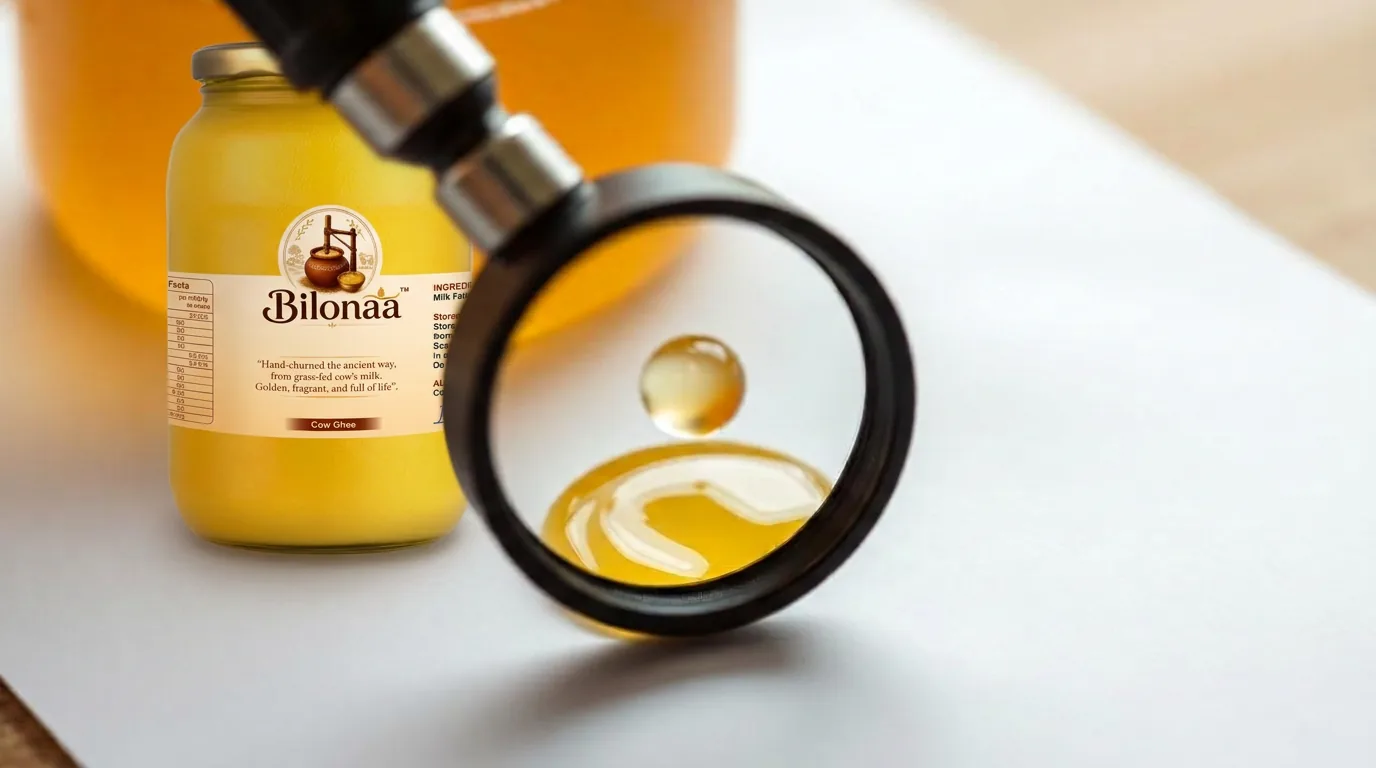
Beyond these home tests, understanding the label and source of your ghee is crucial, as reputable brands like Bilonaa clearly state their traditional, pure A2 desi-cow ghee origins.
Ayurveda profoundly emphasizes the importance of shuddha (pure) ghee, revering it as a vital rasayana (rejuvenator) and a carrier for medicinal herbs.
Modern nutritional science also acknowledges the value of pure ghee, highlighting its healthy short-chain fatty acids, fat-soluble vitamins, and conjugated linoleic acid (CLA).
Proper storage of your ghee is just as important as ensuring its purity, as incorrect conditions can compromise its quality and shelf life over time.
Dispelling common myths about ghee, such as concerns about cholesterol or weight gain, is important when focusing on genuine, pure desi ghee consumed in moderation.
Choosing ethically sourced ghee, like the pure, Bilona-churned A2 desi-cow ghee from Bilonaa, supports sustainable practices and guarantees uncompromised quality.
Finally, incorporating truly pure ghee into your daily diet can elevate your meals and contribute to overall well-being, as Dadi-Nani traditions have always advocated.
"True ghee is not just a cooking medium; it's a golden elixir, a testament to ancient wisdom and careful craftsmanship."
Bilonaa Promise
Small-batch, A2 desi-cow, traditional bilona ghee — straight to your kitchen.
100% pure, hand-churned, slow-cooked on a wood fire and packed in glass jars.
FAQs
Quick answers
What is 'pure' ghee in the Indian context?
In India, 'pure' ghee traditionally refers to clarified butter made from cow's milk, specifically A2 milk, using the ancient Bilona method. This ensures it retains maximum nutritional value and authentic flavour, free from any artificial additives or other oils.
Why is the Bilona method important for ghee purity?
The Bilona method is critical because it involves churning curd, not cream, to extract butter, which is then slow-cooked into ghee. This preserves delicate nutrients, enzymes, and the unique granular texture, distinguishing it from machine-made ghee that uses cream and higher heat.
Does pure ghee always solidify at room temperature?
Pure ghee generally solidifies or has a semi-solid, granular texture at temperatures below 25°C. However, its exact consistency can vary slightly depending on the cow's diet and ambient temperature. If it remains liquid at cool temperatures, it might indicate adulteration.
Can adulterated ghee harm my health?
Yes, consuming adulterated ghee can be detrimental. It may contain cheap vegetable oils, hydrogenated fats, or artificial colours, which offer no nutritional benefits and can contribute to health issues like increased cholesterol, digestive problems, or allergic reactions.
Is the 'Palm Test' truly effective for checking purity?
The 'Palm Test' is a simple, effective initial indicator. Pure ghee will melt quickly upon contact with your body's warmth and absorb into the skin without leaving a greasy, waxy residue, unlike adulterated versions often mixed with vegetable fats.
How does Bilonaa ensure its ghee is pure?
Bilonaa guarantees its ghee's purity by exclusively using A2 desi cow milk and strictly adhering to the traditional Bilona churning process. We maintain transparency about our sourcing from Bikaner, Rajasthan, ensuring no adulteration from milk collection to the final product.
Educational content only — please consult a doctor for medical conditions.
Get gentle ghee notes in your inbox
One thoughtful Ayurveda + kitchen note a week. No spam. Unsubscribe anytime.
Conversation(0)
Share a thought — every comment is read before it appears.