
Bilonaa Method
Making Hand Churned Bilona Ghee at Home: An Honest Step-by-Step
On this page
- Cold morning memories in Bikaner recall the forgotten sound
- True hand churned ghee is defined entirely by the whole-curd
- For centuries across rural India, hand churning was not a go
- Understanding the difference between malai-derived ghee and
- Gathering the right traditional equipment is the first physi
- Culturing high-quality A2 milk into thick, sweet curd forms
- Churning cold dahi with a wooden churner requires a two-way
- Separating fresh makkhan from the remaining buttermilk deman
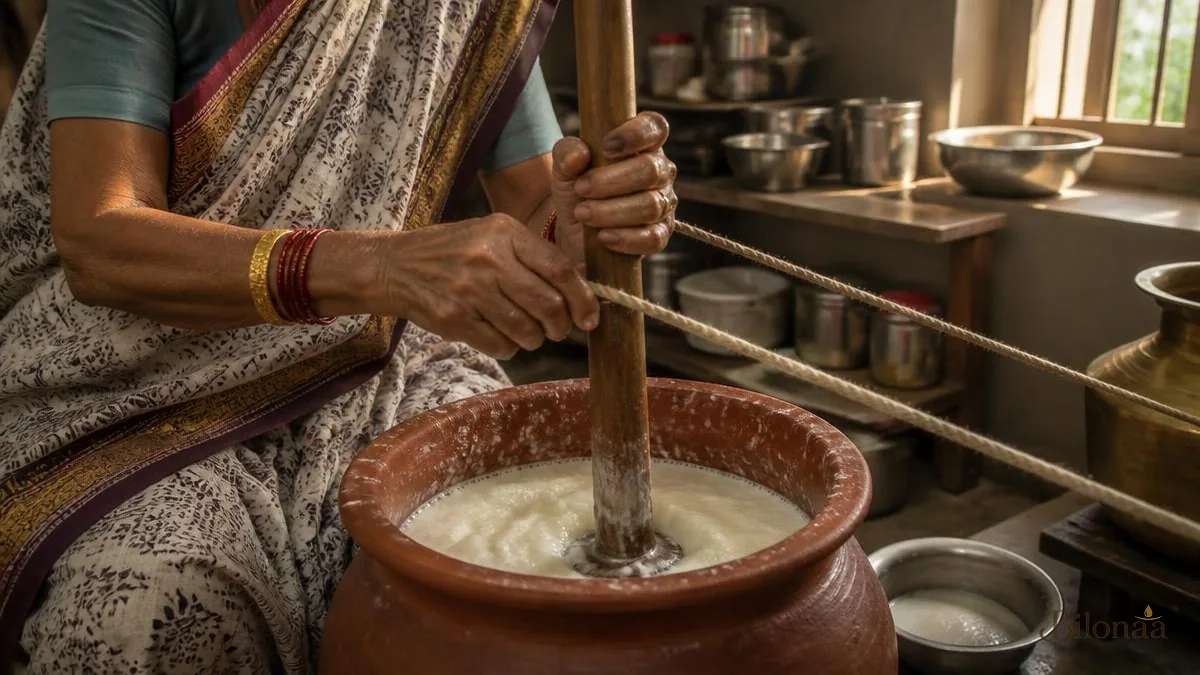
Cold morning memories in Bikaner recall the forgotten sound of authentic hand churned ghee being made in domestic kitchens. If you grew up in a house where dadi-nani spent early mornings sitting on the floor, you know that sound intimately. It was the rhythmic, woody whirring sound of a wooden churner spinning back and forth in a heavy clay pot. Back then, nobody bought plastic tubs or industrial tin cans of yellow fat from the local kirana store. Fat was crafted at home through patience, overnight fermentation, and physical effort. The air in the kitchen always carried a distinct smell—a combination of cool sour curd, sweet fresh butter, and eventually, the nutty toasted aroma of fat simmering in a heavy brass kadhai. Returning to that traditional method today is not about rejecting modernity, but about recovering a depth of flavor and nourishment that industrial processing simply cannot replicate.
True hand churned ghee is defined entirely by the whole-curd fermentation process rather than simply boiling heavy cream skimmed off milk. Most commercial ghee today is made by taking raw cream or direct milk solids, separation via high-speed centrifuges, and melting it down in massive steam kettles. That is technically melted butterfat, not authentic bilona ghee. Real hand churned ghee begins when whole cow milk is boiled, cooled, and converted entirely into curd using a live starter. Only when the full batch of fermented dahi is churned using a two-way wooden churner does the true makkhan separate. This two-way rotation breaks the fat globules gently, preserving beneficial fatty acid structures and allowing delicate aromatic compounds to develop. Without whole curd fermentation and bi-directional churning, you might get a jar of fat, but you will never get true, gut-friendly hand churned ghee.
For centuries across rural India, hand churning was not a gourmet trend but a daily household chore anchored in seasonal rhythms. In Rajasthan, where desert winters bring crisp air and rich milk from native cow breeds like Rathi and Tharparkar, every home had a dedicated corner for churning. Women would wake before sunrise while the temperature was cool, ensuring the fat in the cultured dahi remained firm during churning. Nothing was wasted in this traditional loop. The butter was clarified into ghee for keeping, while the left-over chach was consumed fresh with roasted cumin and rock salt during midday meals. Ghee-making was deeply tied to the natural cycle of the household, balancing nutrition, seasonal climate, and sustainable food conservation. Recreating this tradition today honors an ancient food system built around zero waste and pure, unprocessed ingredients.
Understanding the difference between malai-derived ghee and true bilona ghee reveals why whole dahi fermentation is non-negotiable. Many home cooks save leftover cream layer or malai in the freezer for weeks before boiling it directly into ghee. While this avoids waste, malai collected over weeks often oxidizes and develops a subtle rancid note. More importantly, unfermented cream lacks the beneficial lactic acid and short-chain fatty acids created during curdling. When you churn cultured curd instead of raw cream, the bacteria break down lactose and casein proteins upfront. This microbial transformation gives hand churned ghee its characteristic digestive lightness and deeply comforting, nutty aroma. If your ghee usually feels heavy on the stomach or leaves a greasy coating on your palate, switching from direct cream boiling to the whole-curd bilona route will make a world of difference.
Gathering the right traditional equipment is the first physical step toward making genuine hand churned ghee on your modern stove. You do not need an ancient courtyard, but a few specific tools make a huge difference in texture and output. First, clear a heavy brass, cast iron, or thick-bottomed stainless steel kadhai for the final heating phase. Second, source a hand-carved wooden churner, locally known as a mathani or bilona, rather than relying solely on electric blenders. Electric mixer blades spin at thousands of revolutions per minute, generating heat that melts fragile butter fats prematurely and ruins the grain structure. A wooden mathani keeps the mixture cool and coaxes fat globules into clustering naturally. Finally, keep clean muslin cloth, cold water, and clean glass jars ready for straining and storing your finished batch without chemical leeching.
Culturing high-quality A2 milk into thick, sweet curd forms the critical foundation of the entire artisanal churning process. To yield rich, daanedaar ghee, start with fresh, unadulterated whole milk from native Indian cow breeds like Gir, Sahiwal, or Rathi. Bring four to five liters of milk to a gentle boil in a clean pot, then allow it to cool down naturally until it is lukewarm to the touch—around forty degrees Celsius. Stir in two tablespoons of fresh, active dahi culture, mixing thoroughly so the microbes distribute evenly. Cover the pot with a breathable cloth and place it in a warm, undisturbed spot for eight to ten hours. In cold Bikaner winters, my dadi would wrap the pot in a warm woolen shawl overnight. By morning, you should have a firm, velvety bowl of dahi with a soft layer of natural butterfat settled on top.
Churning cold dahi with a wooden churner requires a two-way rotational motion that coaxes butterfat to bind naturally. Before you begin churning, chill the set curd in the refrigerator for two hours; cold temperatures help the butter fat consolidate much faster. Place your wooden mathani into the pot, holding the rope or rolling the wooden handle back and forth between your palms. The key technique here is alternating clockwise and counter-clockwise rotation, which mimics the traditional wooden bilona system. As you churn, the fat globules collide, rupture their protein membranes, and slowly float to the surface as pale yellow clusters of fresh makkhan. If the butter seems stubborn, pour half a cup of ice-cold water into the pot to encourage separation. Within fifteen to twenty minutes, you will see soft, fragrant lumps of butter floating on top of thin, refreshing buttermilk.
Separating fresh makkhan from the remaining buttermilk demands cold water and a delicate touch to avoid losing precious yield. Gently scoop out the floating butter lumps using clean hands or a wooden spoon, gathering them into a loose ball. Submerge the butter ball immediately into a bowl of ice-cold water and squeeze it gently. This washing step removes residual buttermilk trapped inside the fat matrix, which is vital because leftover milk solids will burn easily during boiling and turn your ghee sour. Repeat this cold-water rinse twice until the water runs reasonably clear. Do not throw away the remaining liquid in your churning pot—that sour, probiotic-rich chach is rich in nutrients and makes incredible kadhi or a digestive drink when seasoned with roasted jeera and black salt.
Simmering fresh white butter in a thick iron kadhai transforms simple fat into liquid gold through gentle, attentive heat. Transfer your washed makkhan into a heavy-bottomed kadhai and set it over a medium-low flame on your stove. As the heat hits the butter, it will melt quickly into a milky, frothy liquid that begins to bubble gently. Lower the flame to the lowest setting and maintain a slow, steady simmer. The kitchen will instantly fill with a rich, sweet fragrance that takes you straight back to traditional Indian village homes. Use a wooden spatula to stir the bottom occasionally, preventing milk solids from sticking and scorching. Watch the froth carefully as water content evaporates; the loud bubbling sound will gradually settle down into a quiet, soft sizzling noise as the liquid clarifies.
The chemical transformation during slow heating burns off water content while caramelizing milk solids into a grainy daanedaar texture. As the water completely cooks out, the milk proteins—primarily traces of casein and whey—settle at the bottom of the kadhai as fine sediment. These solids begin to brown gently, undergoing a mild Maillard reaction that imparts a delicate, roasted nutty flavor to the fat. The liquid changes from cloudy pale yellow to a brilliant, crystal-clear amber tone. Ayurveda suggests that this slow cooking process purifies the fat, transforming raw butter into an easily digestible form that stays shelf-stable for years without artificial preservatives. The small caramelized granules left behind form the seed structure that later creates that iconic, melt-in-your-mouth daanedaar texture as the ghee cools down.
Ayurveda praises hand churned bilona ghee as a tridoshic Rasayana that nourishes digestive fire without causing heaviness or congestion. According to ancient texts, ghee made via the bilona method possesses balanced properties that pacify Vata and Pitta while remaining gentle on Kapha when consumed in moderation. Because the whole curd undergoes microbial fermentation, the resulting fat is rich in butyric acid, a short-chain fatty acid that feeds the intestinal lining and supports smooth digestion. Modern wellness trends often promote raw butter or processed coconut oil, but classical Indian medicine has always favored clarified hand churned ghee for its ability to carry nutrients deep into bodily tissues. Dadi always insisted that a spoonful of asli ghee over warm dal or roti wasn't extra fat—it was the very fuel that kept joints flexible and digestion strong.
Knowing exactly when to remove your kadhai from the flame prevents bitter scorching and yields that coveted golden color. Timing is everything in the final minutes of ghee making. Once the foaming subsides and the sediment at the bottom turns a light golden-brown, turn off the heat immediately. The heavy iron kadhai retains significant heat, so the ghee will continue cooking for a few minutes even off the stove. If you wait until the sediment turns dark brown while still on the flame, residual heat will burn the solids, leaving your batch with a bitter taste and dark brown hue. Allow the kadhai to sit undisturbed for twenty to thirty minutes so the golden liquid cools down slightly and the fine sediments settle firmly at the bottom.
Making hand churned ghee at home requires patience, significant milk volume, and an honest look at household practicalities. Let us be entirely realistic: it takes roughly twenty-five to thirty liters of pure cow milk to yield just one liter of authentic hand churned ghee. When you factor in the cost of high-quality unadulterated milk, the time needed for overnight culturing, manual churning, and careful boiling, home production becomes a labor of love rather than a quick chore. Many urban families simply do not have the hours or milk supply to churn regularly. However, understanding the effort involved gives you immense respect for authentic ghee making and helps you spot genuine small-batch producers who follow these rigorous traditional methods without shortcuts.
Debunking common modern ghee myths helps separate factory-made melted butter from genuine fermented, hand-crafted versions. One widespread misconception is that all yellow ghee sold in attractive glass jars is authentic bilona ghee. In truth, many commercial brands simply add beta-carotene or artificial colorings to industrial palm fat or buffalo butter to imitate cow ghee. Another common myth is that hand churned ghee causes weight gain and clogged arteries. When prepared traditionally from grass-fed A2 cow milk through curd fermentation, ghee contains healthy short and medium-chain fatty acids that body burns efficiently as energy rather than storing as stubborn fat. Real asli ghee, eaten in sensible daily quantities alongside whole foods, has always been a cornerstone of vitality, not cardiovascular distress.
Performing simple purity checks at home allows you to test for unwanted milawat like vegetable fat or starches. If you suspect your ghee contains adulterants like vanaspati or boiled potato starch, simple traditional kitchen tests offer immediate answers. Take a teaspoon of melted ghee in a clean glass vessel and add a pinch of sugar followed by a drop of hydrochloric acid or iodine solution; if the liquid turns red or blue, starch or hydrogenated oils are present. Another quick check is the palm test: place a small scoop of room-temperature ghee on your palm—authentic hand churned ghee melts almost instantly at body temperature due to its clean fatty acid profile. Lastly, real bilona ghee should solidify into a distinctly grainy, daanedaar texture rather than setting into a smooth, waxy, uniform block.
Storing finished ghee properly in glass or stainless steel preserves its subtle aroma and grain structure for many months. Once your fresh ghee has cooled to a lukewarm temperature, strain it through a fine stainless steel mesh or clean cotton cloth directly into a dry container. Glass jars or traditional food-grade stainless steel containers are ideal because they do not react with fatty acids or leach chemicals over time. Always ensure the storage vessel is completely dry before pouring; even a single drop of water trapped in the jar can trigger mold growth over time. Keep the jar in a cool, dark kitchen cupboard away from direct sunlight and moisture. Never dip a wet spoon into your ghee jar, and you will find that pure hand churned ghee remains fresh and fragrant without refrigeration for over a year.
For families who want authentic hand churned ghee without the daily labor, small-batch makers like Bilonaa offer a genuine alternative. At Bilonaa, we follow this exact traditional process in Bikaner, Rajasthan, using pure milk from native Rathi, Tharparkar, Gir, and Sahiwal cows. We churn farm-fresh curd in traditional wooden bilonas and slow-cook the white butter over traditional wood fires in heavy vessels. Our ghee is never mass-produced in industrial factories or made from raw cream, ensuring every batch retains its natural daanedaar texture, rich nutty aroma, and traditional Ayurvedic qualities. Packed cleanly in glass jars and traditional stainless steel dolchis under FSSAI certification, Bilonaa brings the authentic taste of dadi's kitchen directly to your dining table without any compromises or hidden shortcuts.
"Real fat was never bought in plastic tubs; it was crafted through cold mornings, overnight curd fermentation, and physical effort."
Bilonaa Promise
Small-batch, A2 desi-cow, traditional bilona ghee — straight to your kitchen.
100% pure, hand-churned, slow-cooked on a wood fire and packed in glass jars.
FAQs
Quick answers
What makes hand churned ghee different from normal commercial ghee?
Hand churned ghee is made by fermenting whole cow milk into curd and churning it bi-directionally with a wooden bilona to yield butter, which is then slow-cooked. Commercial ghee is usually made by melting raw cream separated via high-speed machines. The fermentation process gives hand churned ghee superior digestion benefits, a distinct nutty aroma, and a natural daanedaar texture.
Can I make authentic bilona ghee at home using an electric mixer?
While an electric mixer or blender can churn curd into butter quickly, high-speed steel blades generate frictional heat that breaks down milk fat prematurely. A traditional wooden mathani churns gently at low speeds, preserving the fat globule structure. For the most authentic grain and aroma, low-speed bi-directional wooden churning is far superior to high-speed blending.
Why is my homemade ghee not turning out grainy or daanedaar?
Grainy texture depends on three key factors: using whole-curd makkhan, slow cooking on a low flame, and letting the cooked ghee cool down slowly at room temperature without moving the jar. Rapid cooling in a refrigerator or overheating during the final boil ruins the crystalline structure, resulting in a smooth or waxy texture rather than classic daanedaar ghee.
How long does homemade hand churned ghee stay fresh?
Properly cooked hand churned ghee stays fresh for up to 12 to 18 months at room temperature when stored in a dry, airtight glass jar or stainless steel container. Always ensure no water comes into contact with the ghee, and always use a clean, dry spoon to prevent microbial spoilage. Refrigeration is not required.
Is hand churned ghee safe for lactose-intolerant people?
Yes, most lactose-intolerant individuals can safely consume hand churned ghee. During whole-curd fermentation, bacteria consume most lactose, and the subsequent slow-boiling process removes remaining water and precipitates milk proteins like casein and whey. Straining leaves behind pure butterfat that contains negligible trace amounts of lactose.
Why is authentic hand churned ghee more expensive than regular store-bought ghee?
It takes roughly 25 to 30 liters of pure A2 cow milk to yield just one liter of hand churned bilona ghee. The multi-step process—boiling, culturing curd overnight, manual bi-directional churning, and wood-fire slow simmering—requires significant time, manual effort, and high raw milk volume compared to industrial cream-melting shortcuts.
What cow breeds produce the best milk for making bilona ghee?
Indigenous Indian cow breeds such as Rathi, Tharparkar, Gir, and Sahiwal yield A2 milk that is traditionally favored for bilona ghee. Their milk fat possesses a distinct balance of fatty acids and natural beta-carotene, giving the final churned ghee its characteristic rich aroma, digestive lightness, and delicate golden hue.
Educational content only — please consult a doctor for medical conditions.
Get gentle ghee notes in your inbox
One thoughtful Ayurveda + kitchen note a week. No spam. Unsubscribe anytime.
Conversation(0)
Share a thought — every comment is read before it appears.