
Cow Breeds
Micro-Climates and Milk: How Thar Desert Forage Shapes What Ends Up in Ghee
On this page
- The composition of milk fat is fundamentally tied to the die
- The Great Indian Desert presents an extreme ecological lands
- Among the native livestock of northwestern Rajasthan, Rathi
- Traditional pastoral management in the Thar relies heavily o
- Supplementary feeding during lean dry months introduces crop
- Agricultural research across global bovine science confirms
- When cows shift from fresh green forage to dry concentrates
- Quantitative research specifically mapping the precise lipid
The composition of milk fat is fundamentally tied to the diet, environment, and metabolism of the dairy animal. Across agricultural science, researchers have long recognized that what a cow eats directly influences the structural lipids, volatile compounds, and fat-soluble constituents found within her milk. In intensive commercial dairy systems, animals typically consume uniform rations composed of grain concentrates, corn silage, and soy meals designed to produce standardized fat yields. By contrast, extensive grazing systems present a dynamic environment where botanical diversity, soil minerals, and seasonal shifts constantly alter the nutritional input. Understanding how forage impacts milk quality requires examining both the biological machinery of the cow and the specific vegetation of her habitat.
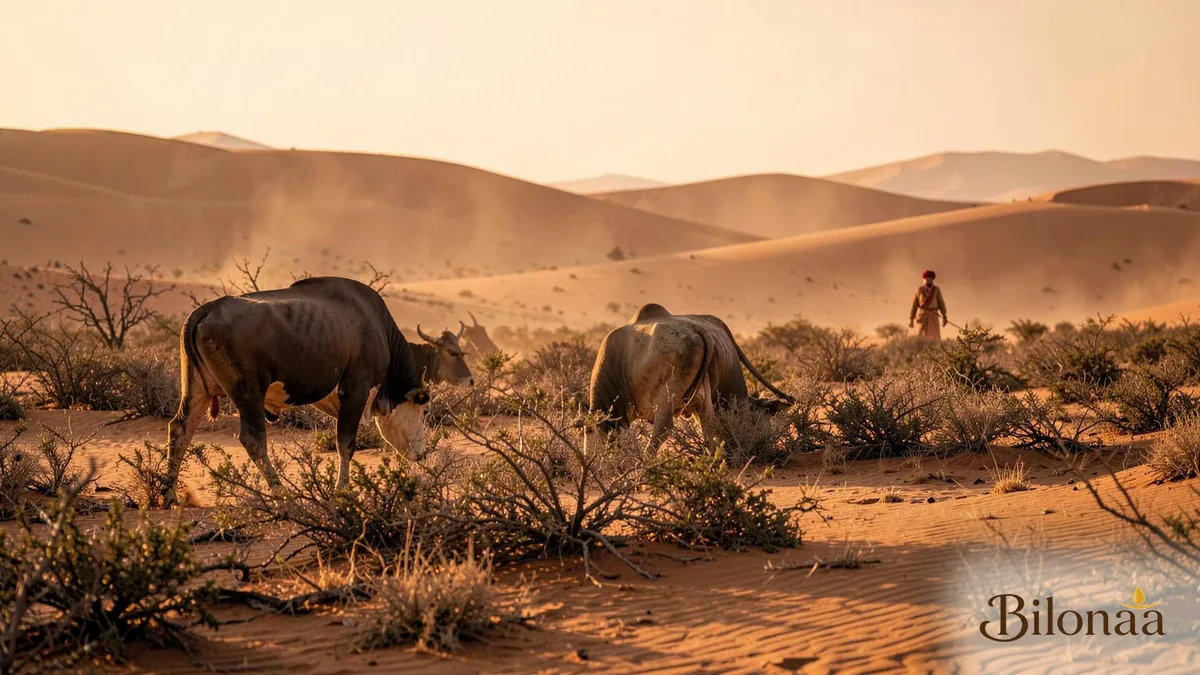
The Great Indian Desert presents an extreme ecological landscape where indigenous cattle breeds have adapted over centuries to harsh climatic realities. Extending across western Rajasthan, the Thar Desert experiences sharp temperature fluctuations, minimal annual rainfall, and prolonged periods of dry intense heat. Far from being a barren wasteland, this hyper-arid ecosystem supports a specialized scrub and grassland flora adapted to low moisture and saline soils. The vegetation includes drought-resistant perennial grasses, deep-rooted shrubs, and leguminous desert trees. Cows grazing across this environment consume a diet drastically different from pasture-fed cattle in temperate zones or stall-fed cattle in industrial dairies.
Among the native livestock of northwestern Rajasthan, Rathi and Tharparkar cattle stand out for their climate resilience and distinct physiological traits. The Rathi breed, originating from the arid tracts of Bikaner and Ganganagar, is renowned for its efficient feed conversion even when consuming dry scrub. The Tharparkar breed, hailing from the neighboring desert districts, exhibits exceptional heat tolerance and an ability to thrive on sparse natural pastures. Centuries of natural selection have optimized their rumen microflora, allowing these zebu (Bos indicus) cattle to break down high-fiber desert plants that would induce severe digestive stress in non-native breeds.
Traditional pastoral management in the Thar relies heavily on seasonal grazing across arid grassland ecosystems dominated by native flora. Chief among these forage species is Lasiurus sindicus, locally known as Sewan grass. Sewan grass is a nutrient-dense perennial grass that forms extensive root networks deep within desert sands, retaining trace minerals and crude protein even during dry months. Alongside Sewan, cattle browse on Dhaman (Cenchrus ciliaris) and Karad (Dichanthium annulatum), as well as leaves from desert trees like Khejri (Prosopis cineraria). This diverse botanical intake introduces a complex array of natural plant compounds, essential fatty acid precursors, and polyphenols into the cow's digestive tract.
Supplementary feeding during lean dry months introduces crop residues such as moth bean and guar straw into the cattle diet. In the rainfed farming systems of Bikaner and surrounding districts, leguminous crops like moth bean (Vigna aconitifolia) and cluster bean or guar (Cyamopsis tetragonoloba) are agricultural staples. After harvest, the dried stems, pods, and leaves are stored as fodder. These leguminous residues are rich in crude protein and structural fiber. When mixed with native grasses, they provide a balanced energy-to-protein ratio during winter and summer months when green pasture grazing becomes restricted.
Agricultural research across global bovine science confirms that forage type directly modifies the fatty acid profile of milk lipid fractions. Studies comparing pasture-grazed cattle with concentrate-fed herds show consistent differences in milk fat chemistry. Fresh green pastures high in alpha-linolenic acid generally increase the proportion of polyunsaturated fatty acids, such as conjugated linoleic acid (CLA) and omega-3 fatty acids, in milk fat. Conversely, diets high in dry concentrates or cereal grains tend to elevate saturated fatty acids like palmitic acid. However, these biochemical pathways depend heavily on how rumen microorganisms process plant fats through a pathway known as rumen biohydrogenation.
When cows shift from fresh green forage to dry concentrates or crop residues, the proportions of short-chain and long-chain fatty acids alter noticeably. During brief monsoon periods when fresh green shoots emerge in the desert, increased intake of active plant lipids can lead to subtle shifts in milk fat soft-chain fatty acids. During dry periods dominated by leguminous straws and mature grasses, the rumen produces higher ratios of acetate to propionate, which typically supports overall fat concentration while shifting the melt point of the fat. This dynamic relationship demonstrates that milk fat is not a static compound, but a fluid reflection of seasonal vegetation.
Quantitative research specifically mapping the precise lipid composition of Thar desert cow milk quality remains surprisingly sparse and geographically limited. While global literature offers robust data on European or American pasture systems, comprehensive peer-reviewed profiles comparing Thar desert native forage diets against controlled concentrate diets are rare. Existing Indian animal science literature offers broad insights into milk yield and gross fat percentages for Rathi and Tharparkar breeds, but detailed fatty-acid chromatograms across specific desert micro-climates are not yet fully standardized. Therefore, consumers and producers must avoid making unverified claims about unique lipid profiles, recognizing that current evidence provides qualitative principles rather than definitive numerical constants.
Comparing seasonal feeding models illustrates how dietary input changes throughout the arid desert calendar in western Rajasthan. | Season | Primary Desert Forage / Feed | Dietary Character | Observed Impact on Milk & Fat Characteristics | |---|---|---|---| | Monsoon (Jul–Sep) | Fresh Sewan grass, wild herbs, green legumes | Higher moisture, active pigments, plant lipids | Softer fat texture, elevated carotene hues, lower melting range | | Post-Monsoon / Winter (Oct–Feb) | Semi-dry native grasses, moth bean crop straw | Balanced fiber & protein, moderate energy | Granular crystal structure, rich aromatic precursor profile | | Dry Summer (Mar–Jun) | Dry Sewan stubble, guar straw, shrub browse | High structural cellulose, low moisture | Firmer fat stability, higher short-chain fatty acid proportion | As shown in the comparison, seasonal shifts in vegetation directly correspond to variations in fat yield, physical texture, and aromatic density.
Ayurvedic tradition views milk and clarified butter through the foundational concepts of desha (territorial ecology) and ahara (dietary input). Classical texts such as the Charaka Samhita note that the therapeutic properties of animal products are directly shaped by the landscape the animal inhabits, the water it drinks, and the plants it consumes. Cows grazing in dry, arid regions (Jangala desha) were traditionally considered to yield milk that was lighter and easier to digest compared to animals kept in marshy, humid zones (Anupa desha). This ancient observational framework aligns conceptually with modern ecology, emphasizing that region and forage define the intrinsic character of dairy products.
Modern nutritional chemistry approaches milk fat not as a single fat, but as a complex matrix of over 400 distinct fatty acids and lipid-soluble constituents. Beyond primary triglycerides, unrefined milk fat carries fat-soluble vitamins including Vitamin A, Vitamin E, and Vitamin K2, alongside trace carotenoids and volatile organic compounds. The exact balance of these compounds determines not only physical parameters like melting point and grain crystallization, but also the nuanced flavor notes of butterfat. Volatile lactones, aldehydes, and ester compounds derived from feed breakdown give regional milk its distinct organoleptic identity.
The transition of milk fat into ghee through thermal processing preserves many stable lipid structures while forming characteristic aroma compounds. When cultured butter is slowly heated to clarify the fat, moisture evaporates, and milk solids undergo mild non-enzymatic browning known as the Maillard reaction. This process generates Pyrazines, furans, and lactones that contribute a deep, nutty aroma to the finished butterfat. Because ghee is virtually anhydrous fat, stable saturated and monounsaturated fatty acids remain intact, protecting the product against rapid oxidation without requiring artificial preservatives or refrigeration.
Artisanal processing techniques significantly influence how fat-soluble compounds and aromatic notes are retained in the final butterfat. Mass-industrial ghee production often relies on direct cream separation and high-heat continuous centrifugation, which bypasses the natural lactic fermentation phase. In contrast, the [traditional bilona method](/traditional-bilona-method) requires boiling fresh milk, cooling it, culturing it into whole curd using natural starter cultures, and hand-churning the curd with a wooden churn to separate butter. This slow, low-temperature cultured process preserves delicate volatile aromatics and yields a distinct granular crystal structure that factory methods cannot replicate.
Ethical herd management and open grazing practices play a crucial role in maintaining consistent milk quality year-round. Allowing cattle to graze naturally reduces physiological stress, which directly affects hormonal balance and somatic cell counts in raw milk. High stress levels in dairy cows are known to disrupt digestion and lower overall milk fat stability. Adopting [ethical calf first dairy economics](/blog/ethical-calf-first-dairy-economics)—where calves are fully nourished before milk is harvested for processing—ensures healthier, longer-lived cows whose metabolic output remains stable across changing seasons.
Genetic variations such as the A2 beta-casein allele operate alongside diet to define overall milk characteristics. Native zebu cattle breeds of India, including Rathi, Tharparkar, Gir, and Sahiwal, predominantly possess the A2 beta-casein gene variant. While genetic testing confirms the presence of A2 protein in raw milk, consumers should note that A2 refers strictly to a protein structure, whereas ghee consists almost entirely of fat. For readers interested in how traditional diets and genetics intersect, studying [epigenetics a2 ghee desi diet](/blog/epigenetics-a2-ghee-desi-diet) offers deeper context, though fat composition itself remains governed by feed and thermal processing rather than protein genetics.
Consumers evaluating ghee quality often mistake natural seasonal variations in color and texture for defects or adulteration. During months when cows consume green forage rich in beta-carotene, butterfat displays a warmer, slightly golden hue. When diets transition to dry crop straws like moth or guar, the resulting fat appears paler and develops a firmer, more pronounced grain structure upon cooling. Recognizing these shifts as natural expressions of seasonal feed, rather than manufacturing flaws, allows consumers to appreciate the true seasonal rhythm of traditional pastoral dairy craft.
Understanding the regional origin of milk allows consumers to appreciate the subtle, natural expression of traditional dairy craft. Rather than seeking artificially uniform food products, discerning buyers value the ecological stories embedded within regional foods. Milk sourced from cows roaming the Thar Desert carries the quiet footprint of Sewan grass, low humidity, ancient zebu genetics, and centuries of pastoral wisdom. When processed thoughtfully without chemical refining or industrial bleaching, clarified butter becomes an authentic reflection of its terroir.
At Bilonaa, we honour the desert landscape of Bikaner by working with indigenous Rathi, Tharparkar, Gir, and Sahiwal cows to craft traditional bilona ghee. Sourced from small-batch pastoral partners in western Rajasthan, our milk is cultured into curd, hand-churned using wooden bilonas, and slow-cooked over low wood fires. Packed carefully in glass jars and traditional steel dolchis under FSSAI license 22226025000262, our ghee retains the raw, seasonal integrity of the Thar landscape. We invite you to browse our collection to [shop Bilonaa ghee](/shop), read [our story](/about) on native breed preservation, or consult our [FAQs](/faq) to learn more about traditional butterfat.
"Milk fat is not a static substance; it is a dynamic biological record of the cow's breed, diet, micro-climate, and seasonal grazing landscape."
Bilonaa Promise
Small-batch, A2 desi-cow, traditional bilona ghee — straight to your kitchen.
100% pure, hand-churned, slow-cooked on a wood fire and packed in glass jars.
FAQs
Quick answers
How does Thar Desert forage affect the flavor of cow ghee?
Native desert plants like Sewan grass, along with leguminous crop residues like moth bean and guar straw, provide a complex mix of dietary fiber, minerals, and natural aromatic precursors. When fermented into curd and slow-cooked into ghee, these plant compounds contribute subtle nutty, earthy aromatic notes that vary naturally across seasons.
Does A2 cow milk fat have a different chemical profile than A1 milk fat?
A2 and A1 refer specifically to variations in beta-casein, which is a milk protein. Ghee is pure butterfat from which protein solids have been removed. While indigenous A2 breeds like Rathi and Tharparkar have unique fatty-acid profiles due to their diet and metabolism, the A2 designation itself applies to protein, not fat.
Why does the color and grain of desert cow ghee change across seasons?
Color and grain variations are entirely natural. Monsoon grazing on fresh green forage introduces higher beta-carotene levels, producing a golden tint and softer fat texture. Dry winter and summer diets based on stored crop residues lead to paler shades and firmer, more granular crystal structures upon cooling.
Are there definitive studies showing Thar Desert milk is healthier than other milk?
Current peer-reviewed scientific literature specifically mapping the fatty acid profiles of Thar desert milk is limited. While pasture-fed milk generally shows favorable fatty acid patterns compared to industrial feedlot milk, no definitive unique health profile should be assumed for Thar milk without further dedicated comparative research.
What breeds of cattle are native to the Thar Desert region of Rajasthan?
The primary indigenous zebu (*Bos indicus*) breeds adapted to the Thar Desert micro-climate are Rathi and Tharparkar cattle. Both breeds are celebrated for their exceptional heat tolerance, high feed-conversion efficiency on sparse arid vegetation, and natural resilience against harsh desert environmental conditions.
How does the traditional bilona method preserve milk fat quality?
The bilona method involves boiling fresh milk, fermenting it into curd with natural cultures, and hand-churning the curd to isolate butter. This low-temperature fermentation and gentle thermal clarification preserve volatile aromatic compounds, natural fat-soluble vitamins, and desirable granular texture better than modern high-heat industrial cream separation.
Educational content only — please consult a doctor for medical conditions.
Get gentle ghee notes in your inbox
One thoughtful Ayurveda + kitchen note a week. No spam. Unsubscribe anytime.
Conversation(0)
Share a thought — every comment is read before it appears.