Seasonal & festival
Til Gud Laddoo Recipe: Ghee, Jaggery Stages and Binding Tips
On this page
- What Makes Til Gud Laddoo Hold Together?
- Ingredients and Preparation
- Set up before heating the jaggery
- Step-by-Step Til Gud Laddoo Recipe
- Roast the sesame gently
- Melt the jaggery
- Cook and test the syrup
- Mix, portion and shape
- Jaggery Stages: Reading the Cold-Water Test
- Too early: the drop spreads or smears
- Ready: a firm, pliable ball
- Too far: a brittle thread or shard
- How Much Ghee Should You Use?
- Binding Problems and Practical Fixes
- The mixture crumbles before I can shape it
- The laddoos stay sticky or flatten
- The laddoos are too hard or greasy
- Cooling, Storage and Serving
- Conclusion
Makar Sankranti brings the familiar fragrance of roasted til and melting gud into many Indian kitchens. These small festive laddoos need only a few ingredients, yet they can be surprisingly tricky: one batch refuses to hold together, while another sets harder than expected.
The secret to a dependable til gud laddoo recipe is understanding what each ingredient does. Sesame provides texture, jaggery forms the binding structure, and a little ghee adds aroma and helps with handling. This guide focuses on the moment when the jaggery is ready and the short window in which the mixture can be shaped safely.
What Makes Til Gud Laddoo Hold Together?
As jaggery melts and cooks, moisture evaporates and the syrup becomes more concentrated. Once mixed with sesame and cooled, it forms the structure that holds the seeds together. Undercooked syrup can leave laddoos sticky or unable to retain their shape; syrup cooked too far produces a much harder bite.
Ghee is not the main binder here. Adding extra spoonfuls cannot correct an undercooked syrup or bring a cold, hardened mixture back to a workable consistency. Too much may leave a greasy surface and make the mixture difficult to gather.
This method makes whole-sesame laddoos with a firm, gently chewy bite, rather than a soft, powder-based laddoo. Jaggery varies in moisture and composition, so judge the syrup by a cooled sample rather than its colour or a fixed cooking time.
Ingredients and Preparation
For approximately 18–20 small laddoos, use 200 g white sesame seeds, 180 g jaggery chopped or grated, 2 teaspoons desi cow ghee, 1 tablespoon water and, optionally, ¼ teaspoon cardamom powder. Keep a little additional ghee aside for lightly greasing your palms and a plate. Yield depends on how large you shape each laddoo.
Use clean, food-grade sesame and jaggery from a reliable source. Softer jaggery sold for chikki or laddoo can be convenient, but the label does not replace checking the syrup stage. Powdered jaggery also works, although its moisture and cooking behaviour may differ.
Keep this first batch simple. Peanuts, coconut and other additions change the proportion of dry ingredients to syrup. Establish the basic method before adapting it, rather than adding a handful of every festive favourite.
Set up before heating the jaggery
Keep a heavy-bottomed kadai, sturdy spatula, lightly greased steel plate and bowl of cold water ready. Measure everything first. Allow roughly 30–40 minutes for preparation and cooking, plus cooling time, but let the ingredient cues guide you.
Hot jaggery sticks to skin and can cause serious burns. Keep children away from the stove and shaping area. Greased palms do not protect against heat: always let a small portion become comfortably warm before touching it.
Step-by-Step Til Gud Laddoo Recipe
Roast the sesame gently
Add the sesame to a dry kadai over low to medium-low heat. Stir continuously, moving seeds away from the edges and back through the centre so they roast evenly.
Look for a lightly toasted aroma and a subtle colour change; a few seeds may begin to pop. Do not wait for the entire batch to turn brown. Taste a few cooled seeds to check that they are pleasantly nutty rather than bitter, then transfer them to a wide plate immediately.
Keep the roasted sesame comfortably warm if possible, but do not leave it in the hot kadai where it can continue browning. Warm seeds slow the sudden cooling of the syrup when the two are combined.
Melt the jaggery
Add the chopped jaggery and 1 tablespoon water to the kadai. Heat gently, stirring until it melts. The water helps it dissolve evenly; it must then cook off as the syrup concentrates.
If the melted jaggery contains visible grit, take it off the heat and carefully strain through a heat-safe metal sieve into another pan before further cooking. Otherwise, add the 2 teaspoons ghee once the jaggery has melted and stir to combine.
Cook and test the syrup
Let the melted jaggery bubble over low to medium-low heat. Stir to prevent scorching and begin testing small drops in cold water. As the syrup approaches readiness, take the kadai off the heat while checking each sample so it does not overshoot.
For this recipe, the cooled drop should gather into a firm ball that holds together when lifted but still yields under pressure. It should not dissolve into the water, smear like paste or snap into brittle shards. The next section explains these differences.
Mix, portion and shape
Once the syrup passes the test, switch off the heat. Immediately add the roasted sesame and optional cardamom. Fold briskly until the seeds are evenly coated, scraping the base and sides of the kadai.
Transfer the mixture to the greased plate. Using two spoons, separate small portions while it is still pliable. Test one portion cautiously; when it is comfortably warm, lightly grease your palms, press it together and roll gently into a ball.
Work steadily rather than squeezing very hot mixture in a hurry. Leave the shaped laddoos in a single layer until fully cool. Their texture will firm up as they stand, so do not judge the final bite while they are warm.
Jaggery Stages: Reading the Cold-Water Test
Too early: the drop spreads or smears
If a small drop disperses in the water or becomes a sticky smear that cannot be gathered, the syrup is not concentrated enough. Continue cooking briefly and test again with fresh cold water.
A very soft ball that immediately flattens or loses its shape is also earlier than the target for this whole-sesame recipe. Stopping here can produce laddoos that slump or remain tacky after cooling.
Ready: a firm, pliable ball
The target sample gathers neatly, lifts out in one piece and holds its shape. Once cooled in the water, it can still be pressed or flattened with firm finger pressure. This gives a useful balance between binding and bite.
Always test the cooled drop, not syrup straight from the spatula. One-thread syrup instructions used for some other sweets are not a reliable substitute for this test, and the darkness of jaggery does not tell you whether it is ready.
Too far: a brittle thread or shard
If the cooled sample breaks with a sharp snap and cannot be pressed into a pliable ball, the syrup has moved towards a brittle candy stage. This may suit chikki, but it gives a harder laddoo than intended here.
If you notice this before adding sesame, remove the pan from the heat. Do not splash water into bubbling syrup. Let it cool substantially before cautiously adding a small measured amount of water, then remelt gently and repeat the tests. Discard jaggery that smells burnt or tastes bitter.
How Much Ghee Should You Use?
Two teaspoons in this batch are enough to contribute flavour without turning the mixture oily. Use only a thin film on your palms and plate. These laddoos do not need the generous quantity of ghee associated with besan laddoo.
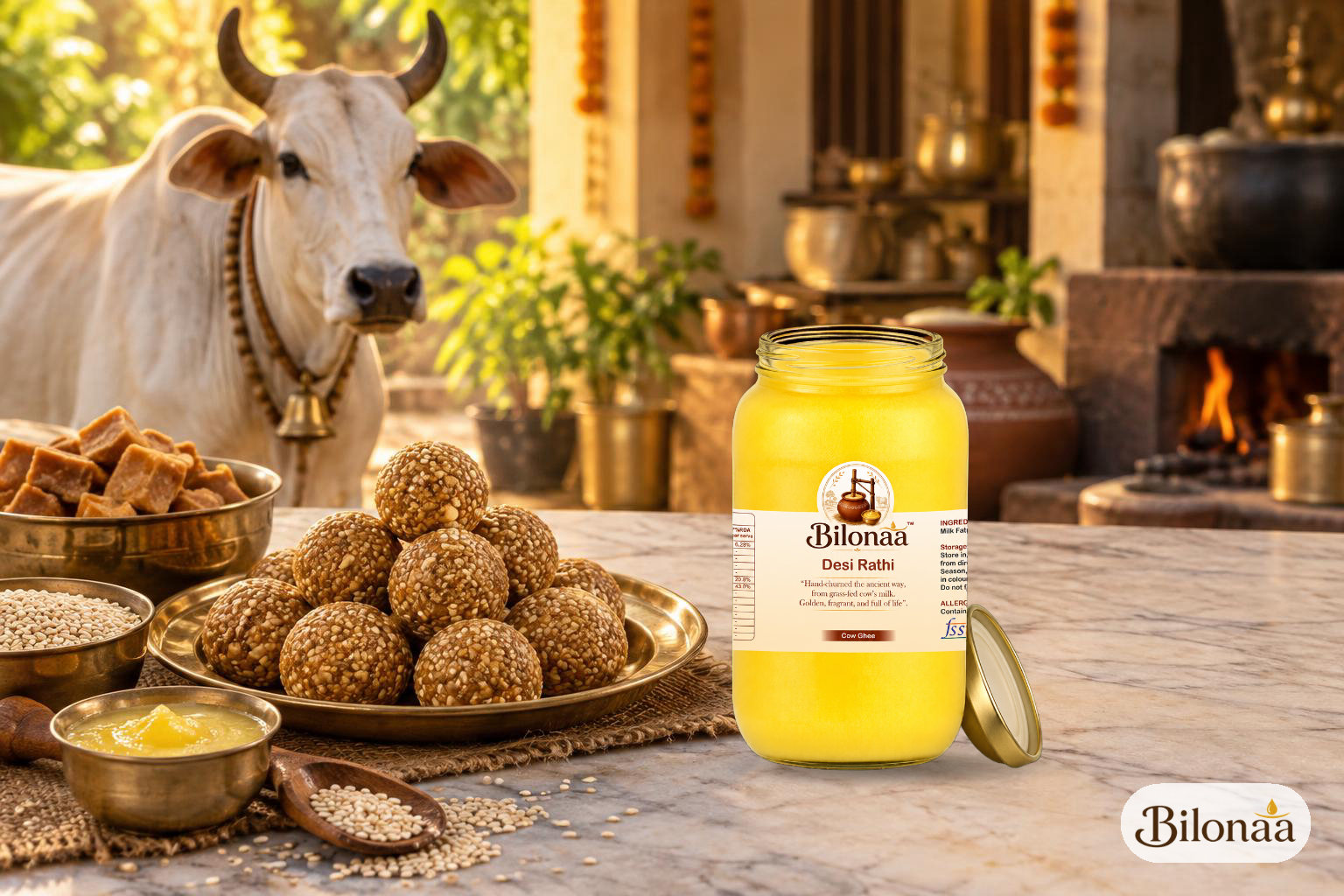
If you prefer traditionally churned ghee, Bilonaa’s Bilona A2 Rathi Cow Ghee is an option for this recipe. In the bilona method, cultured curd is churned to obtain makhan, which is then heated to make ghee. Choose it for your ingredient preferences and its flavour contribution, not as a shortcut to better binding.
Whatever ghee you use, correct syrup concentration and timely shaping remain the deciding factors. A2-labelled ghee does not change the jaggery stage required for the recipe.
Binding Problems and Practical Fixes
The mixture crumbles before I can shape it
First check whether it has simply cooled too much. If the seeds are coated but the mixture has become stiff, return it to the kadai and warm very gently while folding, just until workable. Reheating cannot reliably undo severely overcooked jaggery, so avoid prolonged cooking.
If there are many loose, uncoated seeds, the syrup may not have been distributed properly or the dry ingredient quantity may be too high. Extra ghee will not replace missing jaggery. For a first attempt, weigh the ingredients and mix thoroughly before considering changes.
The laddoos stay sticky or flatten
Allow one test laddoo to cool fully before deciding there is a problem. If it still spreads, undercooked syrup is a likely cause; humid conditions can also make the surface tacky.
An undercooked mixed batch can sometimes be rescued by returning it to low heat and stirring continuously, but the sesame can scorch. Check small cooled portions as you go. Do not add raw sesame or milk as a quick fix.
The laddoos are too hard or greasy
Very hard laddoos usually point to syrup cooked beyond the intended stage. More ghee after setting will not soften the jaggery structure evenly. If the batch is too hard to bite comfortably, do not force it; safely crush manageable pieces for a topping instead.
A greasy finish suggests too much ghee in the mixture or on your palms. Use a lighter coating next time. Making a smaller batch also helps when cooking alone, because you can shape it before the mixture becomes difficult to handle.
Cooling, Storage and Serving
Pack only completely cooled laddoos in a clean, dry, airtight container. Trapped warmth creates condensation, which can make the surface sticky. Store away from steam, sunlight and damp cupboards, and handle with dry hands.
For home planning, make a quantity your household will finish within about a week rather than assuming a long shelf life. Actual keeping quality depends on moisture, hygiene and weather. In hot or humid conditions, refrigerate airtight and let the closed container warm towards room temperature before opening.
Discard laddoos with mould or an off smell. Sesame is an allergen, so mention it when gifting. Hard, round laddoos are also unsuitable for young children who cannot manage their texture safely.
Conclusion
Good til gud laddoo comes down to evenly roasted sesame, jaggery tested at the firm-but-pliable stage and shaping while the mixture is comfortably warm. Keep the ghee measured, test rather than guess, and start with a manageable batch.
For your next Sankranti preparation, explore Bilonaa’s traditionally churned desi cow ghee if it suits your kitchen, and let a carefully cooked batch of til gud laddoo bring the festive flavour to your table.
Bilonaa Promise
Small-batch, A2 desi-cow, traditional bilona ghee — straight to your kitchen.
100% pure, hand-churned, slow-cooked on a wood fire and packed in glass jars.
FAQs
Quick answers
Can I make til gud laddoo without adding water?
Yes, some jaggery melts smoothly without added water over gentle heat. A small measured amount makes dissolving easier for beginners, especially with dry jaggery. It must cook off before the syrup reaches the required stage.
Can I use jaggery powder instead of a jaggery block?
Yes. Use the same weight, but expect cooking behaviour to vary with moisture and composition. Check that it has melted evenly and rely on the cold-water test rather than a fixed cooking time.
Why do my til gud laddoos break while rolling?
The mixture may have cooled too much, the syrup may be overcooked, or there may be too many dry ingredients. Gently warming a cooled mixture can help, but adding more ghee does not correct every binding problem.
Can I grind the sesame for softer laddoos?
Coarsely crushing some roasted sesame changes the bite, but it does not undo a hard jaggery stage. Powder-based soft til laddoos often use a different method, so follow a recipe designed for that texture.
Can I double this til gud laddoo recipe?
You can, but two smaller batches are easier to control at home. A large batch takes longer to mix and shape, increasing the chance that it hardens before you finish. Keep the same ingredient proportions.
Educational content only — please consult a doctor for medical conditions.
Get gentle ghee notes in your inbox
One thoughtful Ayurveda + kitchen note a week. No spam. Unsubscribe anytime.
Conversation(0)
Share a thought — every comment is read before it appears.