
Bilonaa Method
Vedic Bilona Ghee: The Old Method, Explained Without the Marketing
On this page
- Understanding what Vedic Bilona Ghee actually means starts w
- The ancient roots of curd-churned ghee stretch back thousand
- Setting fresh curd from indigenous cow milk forms the founda
- Churning the curd bi-directionally with a wooden bilona sepa
- Slow cooking the washed butter on a low wood fire transforms
- Modern commercial ghee production relies on cream separators
- Examining the chemical composition reveals distinct structur
- Ayurveda regards slow-churned bilona ghee as a vital substan
Understanding what Vedic Bilona Ghee actually means starts with cutting through modern dairy terminology. Walk into any kitchen in Bikaner during a crisp winter morning, and you will smell the distinct, nutty aroma of milk fat gently clarifying in a heavy brass kadhai. That rich, deeply comforting scent is what our dadi-nani knew as asli ghee. Today, the market is flooded with bright yellow jars labeled with complex marketing jargon, yet very few contain ghee made the way Ayurveda originally described. The Vedic method is not about fancy packaging or buzzwords; it is a meticulous five-step traditional technique centered on turning whole cow milk into curd, and then churning that curd bi-directionally with a wooden churner called a bilona. This distinction matters because the standard commercial ghee sitting on supermarket shelves bypasses curd fermentation entirely. When you remove fermentation, you lose the subtle short-chain fatty acids, the deep granulations, and the distinct aroma that made traditional ghee a staple in Indian households for generations.
The ancient roots of curd-churned ghee stretch back thousands of years across rural Indian homes. Long before industrial creameries existed, dairy preservation was both an art and a domestic necessity. In ancient Vedic texts, ghee derived from indigenous cow milk was treated not merely as a cooking medium but as a sacred nourishment used in daily rituals and traditional wellness practices. Every village home kept indigenous breeds like Rathi, Tharparkar, Gir, or Sahiwal, using their nutrient-dense milk to sustain the family. The process was deeply tied to nature's rhythms: fresh warm milk was boiled at dusk, cooled, inoculated with a spoonful of leftover dahi, and left to culture overnight. By early morning, before the sun rose, women of the house would churn the cultured curd using a heavy wooden shaft wrapped in rope. This rhythmic churning was not just about harvesting fat; it was a daily household ritual that preserved the inherent goodness of whole milk without electricity, chemicals, or synthetic additives.
Setting fresh curd from indigenous cow milk forms the foundational step of the entire Vedic process. The quality of final ghee depends almost entirely on the quality of the starting milk and the culturing process. Pure milk collected from free-roaming desi cows is first heated over a mild flame to eliminate undesirable bacteria while retaining vital nutrients. Once cooled down to room temperature, an active mother culture is stirred in to initiate fermentation. Over six to eight hours, beneficial lactic acid bacteria break down milk sugars like lactose and transform the liquid milk into thick, setting curd. This fermentation phase is crucial because it partially digests proteins and converts simple fats into complex, aromatic fatty acids. Commercial dairies skip this step completely because setting thousands of liters of curd requires immense space, time, and physical care. By skipping fermentation, industrial producers save millions in operational costs, but they strip the ghee of its natural gut-friendly character and deep flavor profile.
Churning the curd bi-directionally with a wooden bilona separates butterfat without damaging its natural structure. In the traditional method, the set curd is transferred to a large clay or metal pot, and a wooden churner, known locally as a makhaniya or bilona, is lowered into it. The bilona is rotated back and forth using a rope mechanism, creating alternating vortexes in the curd. This two-way motion mimics natural physical forces, allowing fat globules to collide gently and bind together without heating up the mixture through friction. Cold water is added periodically to encourage butter grains, or makhan, to float to the top while leaving buttermilk, known as chach, at the bottom. This hand-churned makhan is then gathered carefully and washed with clean water to remove residual curd whey. The process requires patience and physical skill, ensuring the fat molecules retain their natural integrity without being oxidized by high-speed mechanical blades found in modern industrial processing plants.
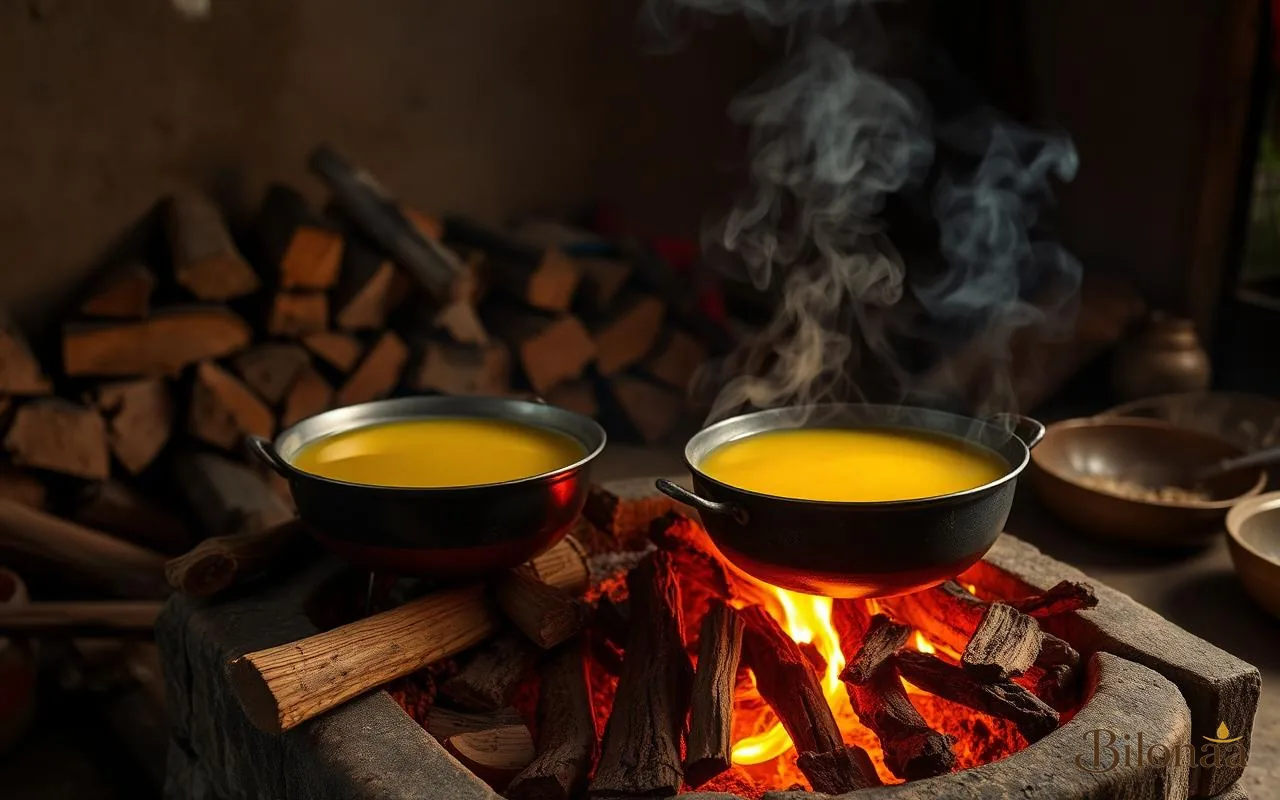
Slow cooking the washed butter on a low wood fire transforms raw fat into aromatic liquid gold. The extracted makhan is placed in a heavy-bottomed kadhai and exposed to slow, consistent heat, preferably fueled by dried cow dung cakes or firewood. As the temperature rises, water content evaporates gradually while milk solids sink to the bottom and begin to caramelize slightly. This slow simmer requires careful monitoring; if the heat is too high, the fat scorches and turns bitter, but if it is too low, the milk solids do not separate cleanly. As the milk solids turn a pale golden brown, the liquid turns completely transparent, filling the air with that familiar, nutty fragrance that signals perfection. The molten ghee is then allowed to settle briefly before being strained through fine cotton cloth. This slow, low-temperature reduction preserves delicate heat-sensitive compounds and creates the prized daanedaar texture as the ghee cools down undisturbed.
Modern commercial ghee production relies on cream separators and high-heat centrifuges that shortcut this entire process. Industrial plants extract cream directly from raw milk using high-speed mechanical separators, completely ignoring the curd fermentation phase. This raw cream is then fed into continuous butter-making machines or directly boiled at extremely high temperatures to yield milkfat quickly. While this industrial method produces thousands of liters per hour at a fraction of the cost, it completely changes the fat profile. Cream-extracted ghee often lacks deep flavor, appears pale or uniform without natural granulations, and can sometimes feel greasy or heavy on the palate. Furthermore, mechanical processing subjects delicate fats to intense friction and sudden thermal stress, which can degrade sensitive fatty acids. When you compare factory-made ghee to traditional bilona ghee, you are looking at two entirely different products made through two fundamentally different physical and biological pathways.
Examining the chemical composition reveals distinct structural differences between curd-based ghee and cream-based ghee. During curd fermentation, natural microflora break down complex milk proteins and lactose, rendering the resulting butterfat virtually free of dairy triggers. This natural bacterial action synthesizes higher concentrations of short-chain and medium-chain fatty acids, notably butyric acid. Butyric acid is well regarded in nutritional science for supporting gut lining integrity and assisting overall digestive comfort. Additionally, the slow wood-fire cooking process creates natural antioxidant compounds through a mild Maillard reaction between residual sugars and amino acids, which helps protect the ghee against oxidative rancidity naturally. Because bilona ghee contains a balanced ratio of omega-3 and omega-6 fatty acids, along with lipid-soluble vitamins A, D, E, and K, its molecular arrangement allows for easier assimilation by the human body compared to industrially processed direct-cream fats.
Ayurveda regards slow-churned bilona ghee as a vital substance for balancing bodily doshas and nourishing deep tissues. In classical Ayurvedic texts like the Charaka Samhita, ghee prepared from cultured cow curd is classified as Sattvic food that enhances Ojas, or vital life energy. It is traditionally believed to soothe internal heat, support digestion (Agni), and carry the therapeutic properties of herbs deep into body tissues without altering its own core nature. Unlike raw oils or heavy industrial fats, curd-churned ghee is considered light on the stomach because the culturing process has already pre-digested heavy milk solids. Traditional vaidyas often recommend a small spoonful of warm bilona ghee taken on an empty stomach in the morning or mixed into hot dal at dinner. Ayurveda specifically emphasizes using milk from humped indigenous cows, as their milk contains specific protein structures and fat proportions that align harmoniously with human physiology.
Kitchen experience changes completely when you cook, temper, or finish dishes with authentic daanedaar ghee. Add half a teaspoon of genuine bilona ghee to a piping hot bowl of yellow dal, and you will notice how the fat blooms instantly, releasing a rich aroma that fills the entire room. When heated in a kadhai for a quick tadka of cumin and mustard seeds, authentic ghee does not smoke excessively or turn acrid quickly due to its exceptionally high smoke point of nearly 250 degrees Celsius. In traditional Indian sweet-making, such as Bikaneri besan ladoo or halwa, curd-churned ghee coats the roasted flour smoothly, creating a melt-in-the-mouth texture without leaving a waxy coating on the roof of your mouth. Its distinctive coarse, grainy structure—the celebrated daanedaar texture—is a clear visual indicator that fat molecules crystallized naturally over time, providing both rich mouthfeel and incredible depth of flavor to simple home-cooked meals.
Comparing A2 bilona ghee against regular market ghee highlights clear differences in aroma, digestion, and shelf life. Most regular market ghee is mass-produced using mixed milk from buffaloes and crossbred exotic cows, extracted directly from cream with chemical neutralizers added to adjust acidity. This results in a flat, uniform fat that often feels heavy in the gut and lacks aroma once cooled. In contrast, A2 bilona ghee derived from native Indian breeds like Gir, Sahiwal, or Rathi offers a light, easily digestible fat profile with a natural golden hue derived from beta-carotene. Because real bilona ghee contains almost zero moisture and negligible milk solids after proper filtration, it naturally resists spoilage without needing synthetic antioxidants, artificial colors, or chemical preservatives. The difference becomes immediately clear when you taste both side by side: one tastes like pure, clean, roasted butter fat, while the other often feels flat and excessively greasy.
Families seeking nutrient-dense whole foods find traditional ghee particularly well suited for daily cooking. If you are trying to cut out ultra-processed seed oils and hydrogenated fats from your daily meals, introducing traditional curd-churned ghee is one of the simplest dietary shifts you can make. It works beautifully for everyday Indian cooking, whether you are brushing warm rotis, tempering lentil soups, or roasting vegetables in a heavy pan. Many elderly family members who struggle to digest regular cream-based market ghee report feeling far more comfortable with traditional bilona ghee because the fermentation process has already broken down complex milk compounds. Children and active adults benefit from the readily available energy provided by medium-chain triglycerides, which are easily converted by the liver into clean fuel rather than being stored as stubborn body fat when consumed in balanced, sensible amounts.
Common myths around ghee fat content and cholesterol often ignore how traditional processing alters digestion. For decades, traditional fats were wrongfully villainized under broad warnings against all saturated fats. However, modern nutritional science increasingly recognizes that naturally occurring saturated fats from whole food sources act very differently in the body than processed trans-fats or chemically refined cooking oils. The fear that eating a spoon of ghee daily will instantly spike cholesterol overlooks how butyric acid and lipid-soluble vitamins in real bilona ghee support metabolic pathways. Another common myth is that yellow ghee is artificially colored; in reality, milk from indigenous cows grazing on natural pasture naturally contains beta-carotene, giving pure A2 bilona ghee a delicate yellow grain. Understanding these distinctions helps families move away from fear-based dietary decisions and return to time-tested, sensible traditional eating habits.
Simple kitchen testing methods help you identify pure bilona ghee from adulterated or cream-extracted substitutes. With widespread milawat in the dairy market, checking purity at home gives you complete peace of mind. The easiest test is the palm test: place a small spoonful of ghee on your palm; authentic bilona ghee has a melting point close to body temperature and will start liquefying almost instantly from your body heat alone. Another simple test involves heating a spoonful of ghee in a clean pan: pure bilona ghee melts quickly and turns a deep brownish golden color within seconds, whereas adulterated or cream-based ghee often takes longer to melt and stays pale yellow or clear. You can also perform an iodine test to check for starch additives like mashed potatoes or flour: add a few drops of iodine solution to melted ghee; if it turns blue, starch has been added to fake thickness.
Understanding the steep cost of authentic bilona ghee requires looking closely at milk yield and manual labor. Consumers often ask why real bilona ghee costs upwards of fifteen hundred to two thousand rupees per liter while commercial ghee is sold for half that price. The answer lies in simple arithmetic: it takes approximately twenty-five to thirty liters of pure A2 indigenous cow milk to produce just one single liter of authentic curd-churned bilona ghee. Native cow breeds yield significantly less milk per day compared to genetically modified or crossbred high-yielding farm cows, making their milk far more precious. When you factor in the labor of boiling milk, setting curd overnight, hand-churning with wooden bilonas, slow-cooking over wood fire, and straining carefully into jars, the higher price directly reflects genuine ingredients, labor-intensive craft, and uncompromising purity rather than inflated marketing margins.
Proper storage in clean glass jars or steel containers keeps traditional ghee fresh for many months without preservatives. Pure ghee is naturally self-preserving because the slow clarified cooking process removes all water content, leaving behind pure fat that resists bacterial growth. To maintain its daanedaar texture and rich aroma, store your ghee jar in a cool, dry place inside your kitchen cabinet, away from direct sunlight and stovetop heat. Always use a clean, dry spoon when scooping ghee, as introducing even a few drops of water or wet food particles can trigger mold growth over time. While plastic containers can leech harmful chemicals into fat over extended periods, glass jars or traditional stainless steel dolchis preserve the natural flavor without any chemical contamination. When stored correctly, genuine bilona ghee will stay aromatic, fresh, and perfectly usable for over a year without refrigeration.
At Bilonaa in Bikaner, we stick strictly to slow wood-fire cooking and wooden bilonas for indigenous cow ghee. Operating right out of Rajasthan, our family brand works with pure A2 milk from native cow breeds including Rathi, Tharparkar, Gir, and Sahiwal. We take pride in following the traditional curd-churning process step by step, setting whole milk curd before hand-churning it with a wooden bilona and simmering the butter slowly over open wood fire. Every batch is crafted under strict FSSAI licensing (22226025000262) without chemical shortcuts, synthetic colors, or cream separators. We pack our small-batch ghee in clean glass jars for quantities up to two liters, and use sturdy traditional stainless steel dolchis for five-liter orders so that the authentic daanedaar texture and royal Bikaneri aroma reach your kitchen exactly as nature intended.
Returning to traditional eating habits begins with small, conscious choices in your everyday pantry. In an era dominated by factory processing, quick fixes, and ultra-refined ingredients, choosing genuine bilona ghee is a meaningful step toward honoring ancient kitchen wisdom and supporting real agricultural traditions. By moving away from cream-extracted industrial fats and embracing authentic curd-churned A2 ghee, you nourish your family with food made with patience, care, and physical integrity. Pay attention to how your body feels after meals, notice the natural aroma blooming in your kadhai, and enjoy the rich depth that only real daanedaar ghee can bring to your daily dining table. Reclaiming real food in your home is not about following temporary health trends; it is about bringing back the clean, soulful flavors that sustained generations before us.
"Real ghee isn't made by pulling cream off warm milk; it takes curd, patience, a wooden makhaniya, and a gentle fire."
Bilonaa Promise
Small-batch, A2 desi-cow, traditional bilona ghee — straight to your kitchen.
100% pure, hand-churned, slow-cooked on a wood fire and packed in glass jars.
FAQs
Quick answers
What is the primary difference between bilona ghee and regular commercial ghee?
Bilona ghee is made by churning whole cultured curd using a wooden churner before slow-cooking the butter fat. Regular commercial ghee skips curd fermentation entirely, extracting raw cream directly from milk using mechanical high-speed separators, which results in a flatter aroma and different fat profile.
Why is authentic Vedic bilona ghee significantly more expensive?
It requires roughly 25 to 30 liters of pure A2 indigenous cow milk to churn just 1 liter of bilona ghee. Native cow breeds yield limited milk daily, and the process involves manual labor, curd setting, wooden churning, and slow wood-fire cooking, making production far more resource-intensive.
Is bilona ghee suitable for people who are lactose sensitive?
Many people with mild lactose sensitivity find traditional bilona ghee comfortable to digest. The culturing process breaks down lactose into lactic acid, and slow clarification removes virtually all liquid whey milk solids, leaving behind almost pure, digestible fat fat free of casein and lactose.
How can I easily test the purity of bilona ghee at home?
Place a small spoon of ghee on your palm; pure bilona ghee melts quickly near human body temperature. Alternatively, heat a spoon in a pan—pure ghee turns brownish-golden instantly and smells nutty, while adulterated ghee takes longer to melt and stays pale or clear.
Why does real bilona ghee have a grainy or daanedaar texture?
The daanedaar texture develops naturally when ghee is cooled slowly without artificial rapid chilling. Different fatty acid chains, especially those present in curd-churned A2 cow fat, solidify at slightly different temperatures, creating distinct, natural crystalline grains.
Should I store my bilona ghee in the refrigerator?
No refrigeration is needed. Pure bilona ghee has practically zero moisture, making it naturally shelf-stable. Keep it in a dry glass jar or stainless steel container away from direct sunlight, and always use a clean, dry spoon to avoid moisture contamination.
Educational content only — please consult a doctor for medical conditions.
Get gentle ghee notes in your inbox
One thoughtful Ayurveda + kitchen note a week. No spam. Unsubscribe anytime.
Conversation(0)
Share a thought — every comment is read before it appears.